Chess tournaments for kids in Kenya: from the kitchen table to the nationals
A record 4,700 children played the national under-17 championship in 2026. The winners flew to Malaysia. The road from your table to the hall is shorter than most parents think.

, 3 min read
On this page
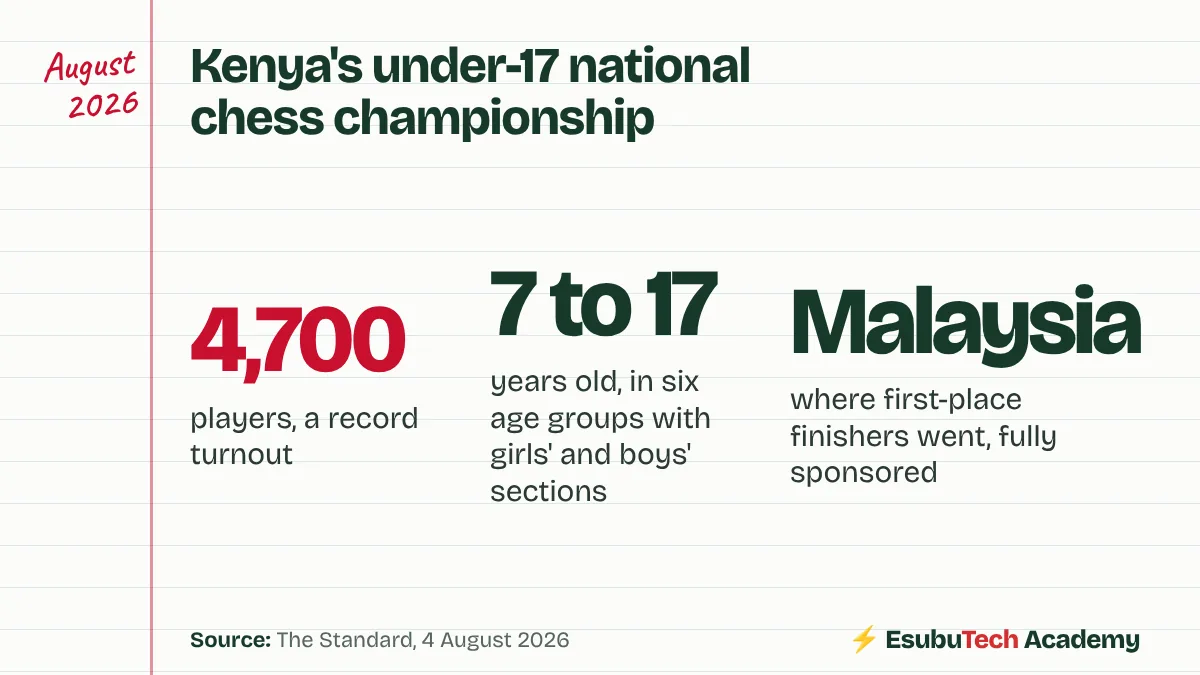
In August 2026, the halls at Alliance High School and Alliance Girls filled with children bent over chessboards. 4,700 of them, aged 7 to 17, played the Kenya Under-17 National Chess Championship. The Standard called it a record.
The winners in each age group earned full sponsorship to represent Kenya at the Commonwealth Schools Chess Championship in Kuala Lumpur, Malaysia. Players who scored seven points or more were invited too, at their own cost.
Look at the youngest section. Under-7. Children still learning to read storybooks, sitting through tournament rounds against strangers.
“Tournament chess is for prodigies”
Most parents picture a national chess championship as a gathering of geniuses. Their own child plays at home and sometimes beats a cousin. It feels like enough.
The numbers say otherwise. You don’t get 4,700 children by inviting prodigies. You get them from clubs, schools and families who decided to take the next step. Many of the age-group winners named by The Standard came from chess clubs, such as Mavens Chess Club, and from schools. None came from nowhere.
Talent rarely separates a child at home from a child at the nationals. The number of serious games does: games against strangers, with a clock, written down and reviewed afterwards.
Children at the nationals aren’t born different. They’ve played more games against strangers, and looked back at each one.
What a tournament asks of a child
Think about what happens at the board. Your child sits across from someone they’ve never met. A clock ticks. Nobody helps. If they lose a piece, they live with it for the next forty minutes. When the game ends, they shake hands, win or lose, and walk to the next round.
For an hour, a nine-year-old makes every decision alone and owns every result. Ask yourself where else in their week this happens.
The road, step by step
Chess Kenya runs the national youth championships. Its 2026 youth and cadets event had sections from under-8 to under-18, open and girls, and was FIDE-rated. Entry came through regional qualifiers: players needed at least two points there to play at the national event.
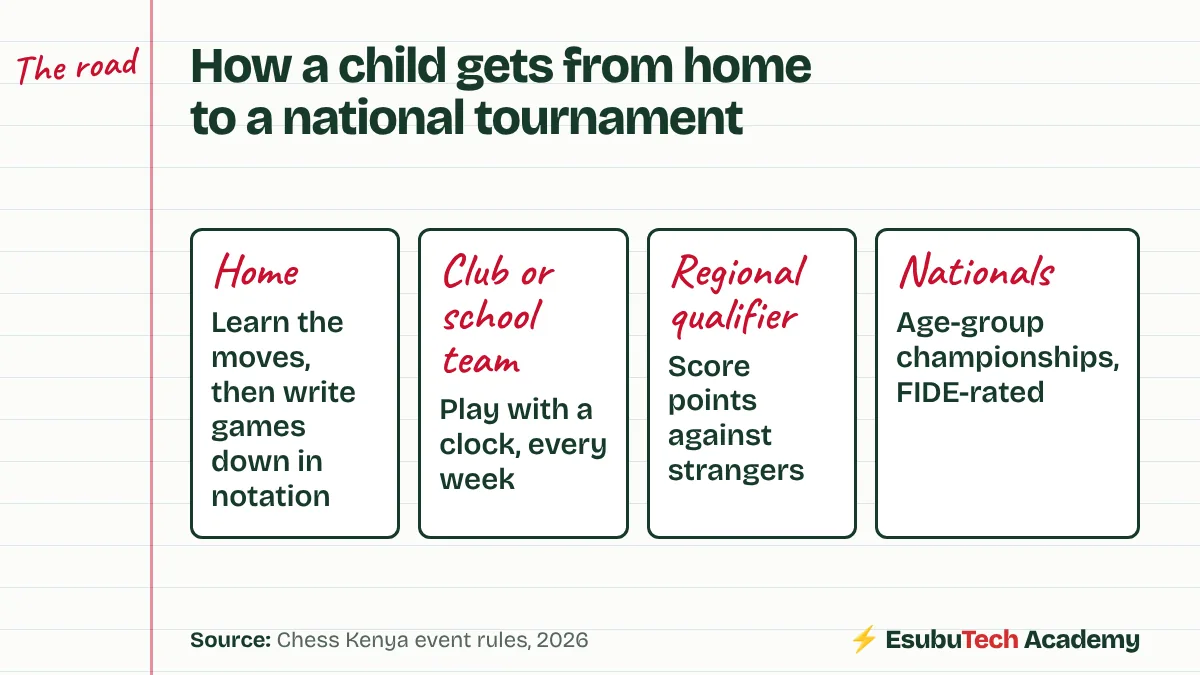
Each step, from a family’s side:
At home, learn every rule, including castling and promotion, then learn notation so your child writes down each game. Our seven-day plan for teaching chess at home covers the rules.
Next, find a club or school team. Ask your child’s school first. Clubs give your child weekly games against players they don’t know, and a chess clock.
Then watch the Chess Kenya events page for regional qualifiers in your area. Entry fees and deadlines change, so confirm them with the organisers listed on each event.
At the nationals, results count toward a FIDE rating, the international number every serious player carries.
Before you sign up for anything
Read the Chess Kenya event rules for your child’s age group, and call the organisers with questions. Ask at your child’s school whether a teacher takes a team to the regional events.
Then ask your child the question which matters most. Do they want to play strangers? Some children love the pressure. Others need another year of club games first. Both are fine. The road stays open.
A child who loses at a tournament and comes back the next month learns something no classroom teaches. Our post on what to do when your child cries after losing helps with the hard part.
Check this yourself
The sources behind this post. Read them, and read the people who disagree, before you decide.
- Kenya's young chess masters shine at U17 national championship (The Standard, 4 August 2026)4,700 players aged 7 to 17, winners sponsored to the Commonwealth Schools Chess Championship.
- 2026 Kenya National Youth and Cadets Chess Championships (Chess Kenya)Under-8 to under-18 sections, FIDE-rated, entry through regional qualifiers. Confirm fees and deadlines with the organisers.
- Chess Kenya, frequently asked questionsJunior and senior membership, and the events page.
Sammy founded Esubu Tech Academy and designs its coding and chess curriculum. He holds a BSc in Data Science from KCA University and is studying for an MSc in Artificial Intelligence at the Open University of Kenya. He learned to code as an adult, after years of unfinished tutorials, and teaches children so they start sooner.