Short videos and your child's focus: what 71 studies found, and how to rebuild attention
Your child watches a two-hour film without blinking, then won't sit with ten minutes of homework. A large review of the research explains part of the puzzle.

, 4 min read
On this page
Watch your child at 8pm. The homework book is open. Two minutes in, the pencil stops. The eyes drift to the window, then to the phone on the table, then back to the page. A question gets asked about something unrelated. Ten minutes later, one sum is done.
The same child sat through a two-hour film on Saturday without moving. So the child has attention. Something about the homework, or the evening, or the habits around it, keeps it from showing up.
“My child has no concentration”
Parents say this like a fact about the child, the way you’d say “she’s tall”. It sounds fixed. It isn’t, for most children.
Attention grows with practice. A child who runs every morning runs further in a month. A child who practises staying with one thing for longer gets better at staying with it. The reverse holds too: practise switching every few seconds, and switching gets easy while staying gets hard.
Now look at what most children practise for hours a week. Short videos last seconds, often under a minute, by design. Each swipe brings something new. A child who spends two hours a day swiping practises the switch hundreds of times.
What 71 studies found
In 2025, a team led by Lan Nguyen at Griffith University pulled together 71 studies on short-form video, covering 98,299 people. Their review appeared in Psychological Bulletin, a leading psychology journal.
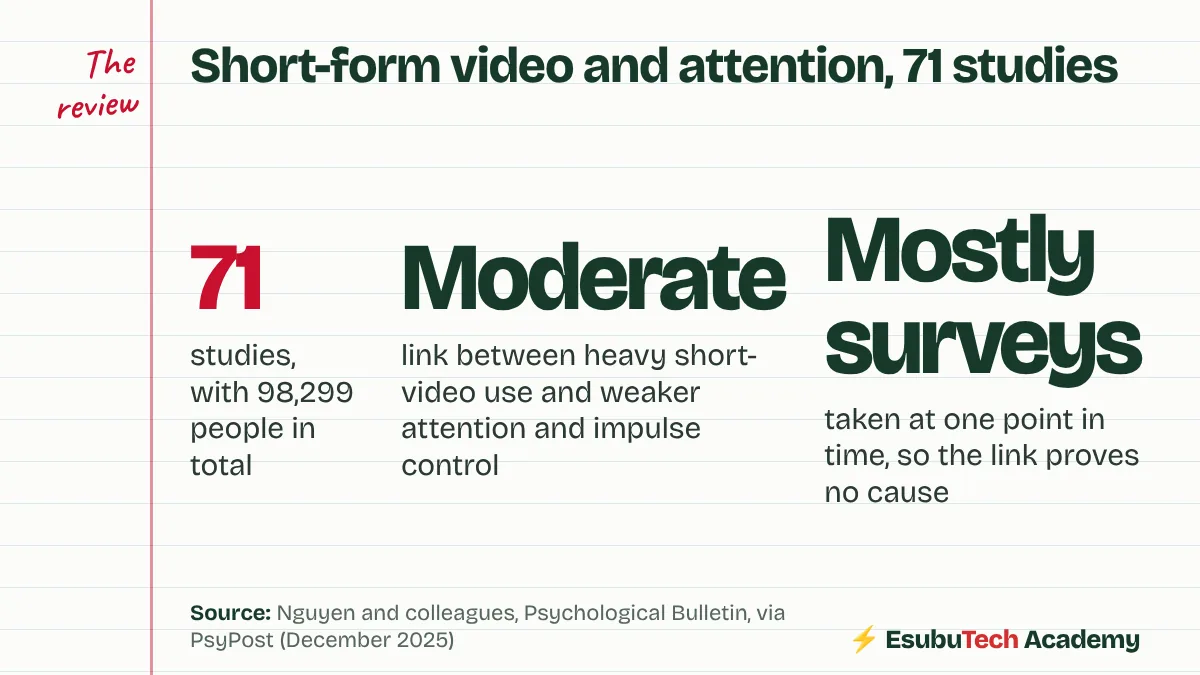
Heavier short-video use went with weaker attention and weaker inhibitory control, the brake which stops you acting on every impulse. The link was moderate, and it showed up most consistently for those two skills.
Read the limits as carefully as the finding. Most of the studies were surveys taken at one moment, so they show a link and don’t prove the videos caused it. Children who already struggle with attention might be drawn to short videos in the first place. Much of the research came from Asia, with adults and young people mixed together.
Every swipe is a tiny lesson in leaving. Two hours of lessons a day add up.
Ask what your child practises
Make a rough list of your child’s week. How many hours go to things which change every few seconds? How many go to one thing held for twenty minutes or more: a book, a puzzle, building something, a long game of chess?
Most parents are surprised by the second number. In many homes, the only long task in the week is the homework, and it’s the one the child resists most.
Climb the focus ladder
You don’t need to ban anything to start. You need one daily slot where your child practises staying with one thing, and a length which grows slowly.
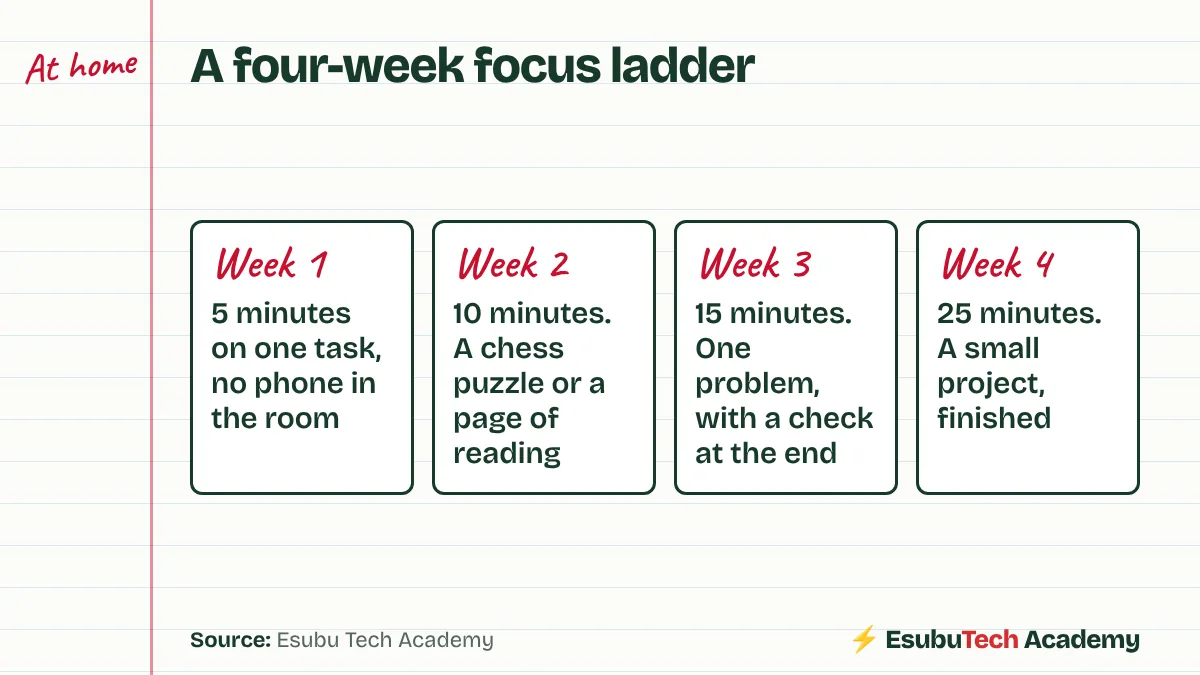
Pick tasks with a clear end. A chess puzzle has an answer. A Scratch project either works or it doesn’t. A page of a novel ends. Children stay longer when they see the finish line.
Keep the phone in another room during the slot, yours included. And notice the moment your child pushes past the urge to quit. Say it out loud: “You stayed with it.” Children repeat what gets noticed.
When to look further
If your child struggles to focus everywhere, at school, in play and in conversation, and the ladder doesn’t move after a month, talk to the class teacher and your doctor. Attention problems have many causes, and a professional is the right person to sort them out.
For many children, the problem is practice. Read the review summaries linked below, then count the long tasks in your child’s week. Our post on screen time: watching against building shows how to give one hour a day a different job.
Check this yourself
The sources behind this post. Read them, and read the people who disagree, before you decide.
- Large meta-analysis links TikTok and Instagram Reels to poorer cognitive and mental health (PsyPost, December 2025)Summary of the Psychological Bulletin review: 71 studies, 98,299 participants, mostly cross-sectional.
- Is all that scrolling dulling your attention? (Silicon Canals)A second summary of the same review.
- About LichessFree chess puzzles, a good first rung on the ladder.
Sammy founded Esubu Tech Academy and designs its coding and chess curriculum. He holds a BSc in Data Science from KCA University and is studying for an MSc in Artificial Intelligence at the Open University of Kenya. He learned to code as an adult, after years of unfinished tutorials, and teaches children so they start sooner.