Should your child use ChatGPT for homework? What happened to 1,000 students who did
The homework looks better than ever. The exam tells a different story. A study of nearly 1,000 high school students measured the gap.

, 4 min read
On this page
Your child used to take an hour over the composition. Tonight it took ten minutes. The paragraphs are neat, the spelling is perfect, and one sentence uses a word you have never heard your child say out loud.
You know what happened. The question is whether it matters.
“AI is the future, so let them use it”
The argument for letting children use ChatGPT on homework sounds modern. Every job will use AI. Children should learn the tools early. Banning it is like banning calculators.
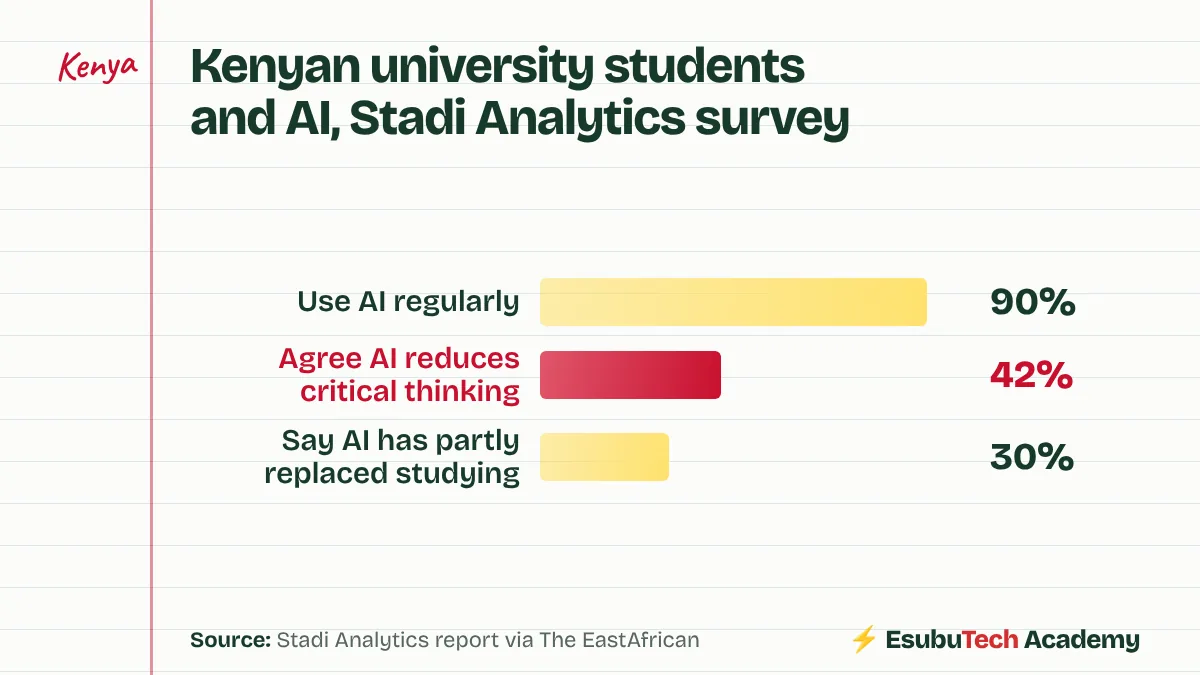
Kenyan students have already made up their minds. A Chegg.org survey of university-age students in 15 countries found 63% of the Kenyan group had used generative AI for their studies, the highest share of any country. A Nairobi research firm, Stadi Analytics, found 90% of Kenyan university students use AI regularly.
A team of researchers ran the test parents need. Hamsa Bastani and colleagues gave nearly 1,000 high school maths students in Turkey access to GPT-4 during practice sessions, and compared them with students who studied from textbooks only. Their results appeared in the Proceedings of the National Academy of Sciences in 2025.
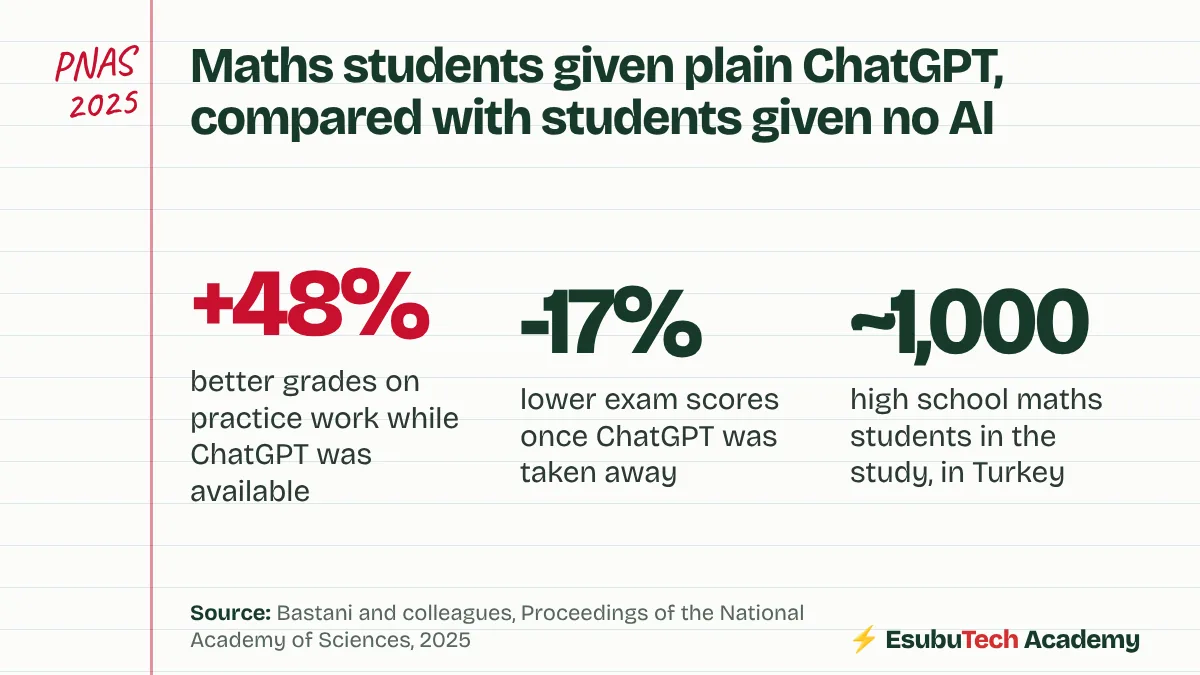
With plain ChatGPT open, students did 48% better on their practice problems. Then the researchers took the AI away and gave everyone the exam. The ChatGPT group scored 17% lower than the students who never had it.
The tool made the homework look better and the learning worse.
Homework exists to make your child do the thinking. When a machine does the thinking, the homework is finished and the learning never started.
The students noticed it themselves
Back in Kenya, the Stadi Analytics survey asked university students how AI affects them. More than 42% agreed it reduces critical thinking. About 30% said chatbots had partly replaced studying. Over one in ten said they couldn’t remember content they had submitted, because AI handled it.
These are adults at university, choosing for themselves. Your child is younger, with less practice at noticing when they’ve stopped thinking.
One detail in the study changes the advice
The researchers tested a second version, called GPT Tutor. It was told to give hints and ask questions instead of handing over answers. Students using it did 127% better in practice, and in the exam they scored about the same as students with no AI.
The damage came from AI handing answers to a child who hadn’t tried yet.
Rules for your house
- First attempt without AI, every time. The child writes something, even a rough version.
- If AI comes in, it asks questions and gives hints. Type “don’t give me the answer, ask me questions” at the start.
- After any AI help, your child explains the answer to you out loud, without the screen.
- Check the age rules. In 2023 OpenAI said children under 13 should not sign up and teenagers needed a parent’s permission.
Try it yourself
Open ChatGPT, paste in one of your child’s maths questions, and read the answer. Then ask your child to solve a similar question on paper. The gap between the two tells you more than any study.
Read the Bastani paper too. It covers one country, one subject and one age group, so treat it as a strong warning, not the final word. Notice which version of the tool helped and which one hurt.
Your child will use AI for the rest of their life. The skill worth building now is knowing when the machine is wrong. Only a child who has done the thinking first will spot it.
Our post on whether children should still learn to code now AI writes code takes this further.
Check this yourself
The sources behind this post. Read them, and read the people who disagree, before you decide.
- Generative AI without guardrails can harm learning (Bastani et al., SSRN and PNAS 2025)GPT Base: 48% better in practice, 17% worse in exams. GPT Tutor: 127% better in practice, about the same in exams.
- Alarm as AI replaces studying for Kenyan university students (The EastAfrican)Stadi Analytics: 90% use AI regularly, over 42% say it reduces critical thinking.
- Kenyan students leading in AI use, survey says (The EastAfrican)Chegg.org survey: 63% of Kenyan students had used generative AI for their studies, the highest of 15 countries.
- Teens need parent permission to use ChatGPT (EdSurge, November 2023)OpenAI's age rules as reported in 2023.
Sammy founded Esubu Tech Academy and designs its coding and chess curriculum. He holds a BSc in Data Science from KCA University and is studying for an MSc in Artificial Intelligence at the Open University of Kenya. He learned to code as an adult, after years of unfinished tutorials, and teaches children so they start sooner.