Only 32 in 100 Grade 9 learners met the maths mark. How to help your child at home
Most parents answer a poor maths mark with more homework help. A study of 438 children found when the help backfires.

, 4 min read
On this page
It’s 9pm on a Tuesday. The maths homework has been open for an hour. Your child has rubbed out the same answer three times, and the page has a hole in it. You lean over to help and hear yourself say it: “Don’t worry, I was never good at maths either.”
Most Kenyan parents have said some version of this sentence. It sounds kind. A study from the University of Chicago suggests it does more damage than the homework.
First, the size of the problem. In the 2025 KJSEA, the first national assessment of Grade 9 learners, only 32.44% met or exceeded expectations in Mathematics. Over 1.13 million learners sat it.
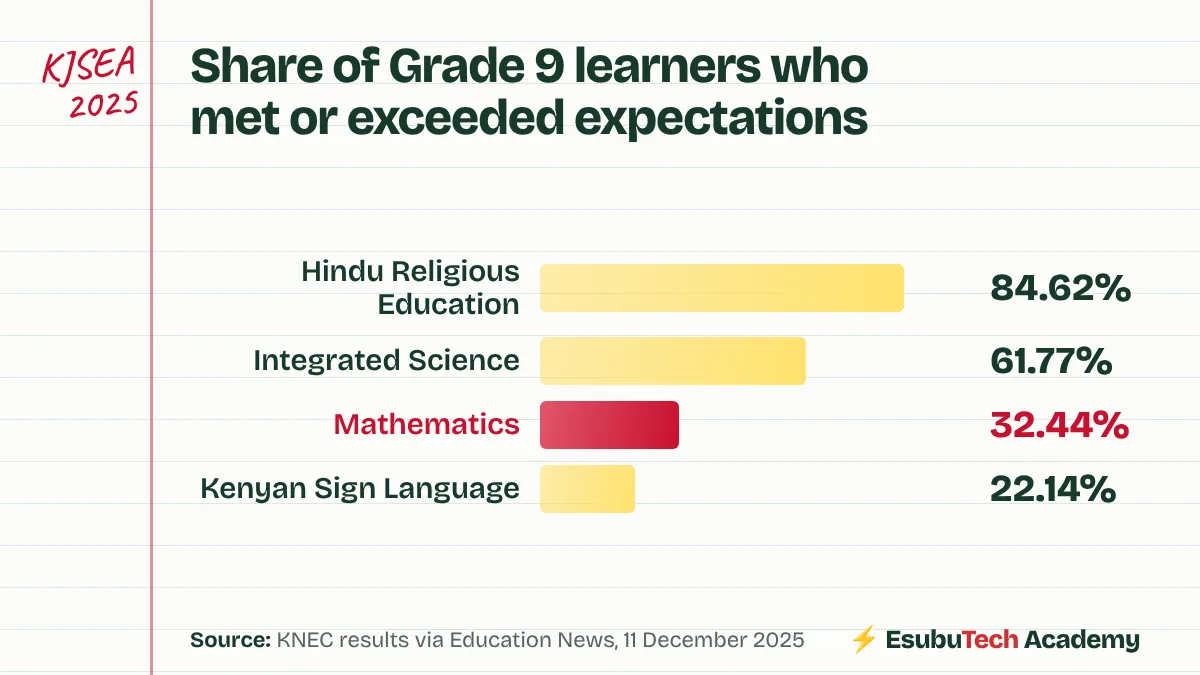
About two in three children finished junior school below the line in maths. Thousands of homes look like yours at 9pm.
“Some children are not maths people”
The belief comes in two parts. Some children have a head for numbers and some don’t. And for the ones who don’t, more help at home fixes it.
The second part is where the Chicago study bites. Researchers led by Erin Maloney followed 438 children in their first two years of school, and their parents, for a full school year. They measured how anxious each parent felt about maths.
Children of maths-anxious parents learned less maths over the year, and grew more anxious about maths themselves. The finding has a twist. This happened only in homes where the anxious parent helped with maths homework often. Where those parents helped less, the link disappeared. Reading results showed no such pattern.
The researchers point to attitude, not genes. A parent who tenses up, sighs, or rushes to the answer shows the child what maths feels like. The child learns the feeling along with the method.
Your child learns two things at the homework table: the method, and how maths feels. The second one lasts longer.
Ask a harder question
Think about your own first memory of maths. Was it a number, or a feeling? A teacher with a cane, a page of red crosses, a classmate who always finished first?
Now think about what your child will remember from this year, long after the marks are forgotten.
Prepare the soil
Before a child in my classes builds a game, we spend time on the maths underneath it. Counting steps. Left and right, up and down. More than, less than. Coordinates on a grid. I call it preparing the soil. When the coding starts, the ideas have somewhere to grow.
You do the same at home, without a single worksheet.
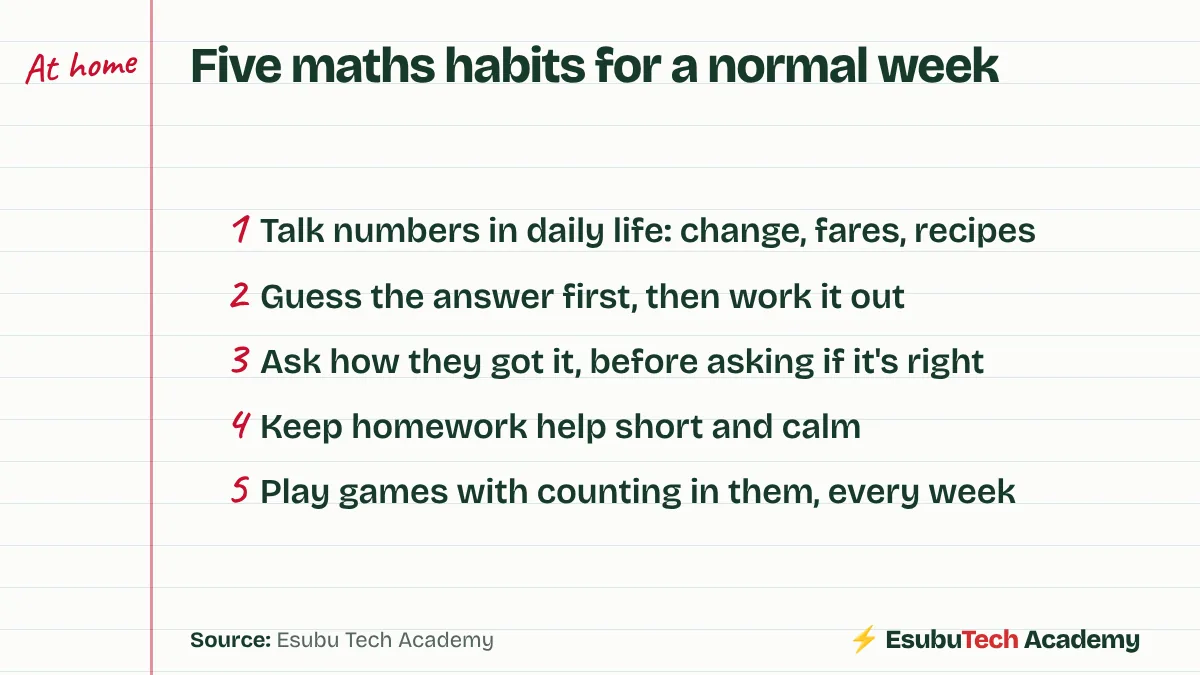
Talk numbers in daily life. How much change from 500 shillings? If the matatu fare is 80 shillings each, what do four of us pay? Half of this recipe, how many cups of flour?
Guess first, then work it out. “About how many?” takes the pressure off being exact, and builds the sense of size most children lack.
Ask how they got it before you ask if it’s right. A child explaining a wrong answer often finds the mistake mid-sentence. You never have to say “wrong”.
Keep homework help short and calm. If maths makes you tense, sit beside your child and ask them to teach you the method. You learn something, and they practise explaining.
Play games with counting in them. Cards, dominoes, bao, chess, any board game with dice. Twenty minutes, twice a week, adds up over a term.
Check the research, and the report form
Read the Chicago study for yourself. It tracked young children in the United States, so treat it as a strong clue, not a Kenyan law of nature. Then look at your child’s report form and ask the teacher which topic in maths sits lowest. Work on one topic at a time.
Ask yourself one more question. Who helps with maths homework in your house, and how does this person feel about maths? If the honest answer is “anxious”, hand the job to someone calmer for a term and watch what changes.
Maths marks move slowly. The feeling about maths moves first.
Check this yourself
The sources behind this post. Read them, and read the people who disagree, before you decide.
- Mathematics, Kenyan Sign Language post lowest scores in 2025 KJSEA results (Education News, 11 December 2025)Subject results for 1,130,459 candidates.
- Parents' math anxiety can undermine children's math achievement (University of Chicago, 2015)Maloney and colleagues, Psychological Science. 438 first and second graders followed for a school year.
Sammy founded Esubu Tech Academy and designs its coding and chess curriculum. He holds a BSc in Data Science from KCA University and is studying for an MSc in Artificial Intelligence at the Open University of Kenya. He learned to code as an adult, after years of unfinished tutorials, and teaches children so they start sooner.