Five chess tactics every child should know, and how to train the eye to see them
Your child knows how every piece moves and still loses a knight every game. The missing piece is pattern training: five tactics, seen so often they jump off the board.

, 5 min read
On this page
Watch a child’s first few months of chess and you’ll see the same moment again and again. The game is going well. Your son moves his queen forward, proud of the attack. Two moves later a knight lands in the middle of his pieces, checks his king and takes the queen.
He knew how the knight moves. He’d been told about forks. He still didn’t see it coming.
“My child knows the rules, so more games will fix it”
Parents often think chess improves the way running does: play enough and you get better. Games help. Many children still play hundreds of games and keep losing pieces to the same few tricks.
The rules tell a child what each piece does. They don’t train the eye to see the pattern in a crowded position, a second before the opponent does. Many pieces lost in children’s games fall to a short list of these patterns, and each one has a name.
What a memory test showed about strong players
In 1973, the psychologists William Chase and Herbert Simon ran a simple test. They showed a master, an advanced player and a beginner a chess position for a few seconds, then asked each to rebuild it from memory on an empty board.
On positions from real games, the stronger the player, the more pieces they placed. On pieces scattered at random, the stronger players lost most of their edge. Earlier work by Adriaan de Groot had found the same with masters.
Chase and Simon’s explanation was chunks. A strong player doesn’t see 25 separate pieces. They see familiar groups, such as a castled king with three pawns in front, stored from thousands of earlier games. Their memory is ordinary. Their library of patterns is huge.
A strong player sees a fork the way you read a word: all at once, without spelling it out.
So tactics are learnt the way children learn to read. They have to be seen many times, named, and found again in new places.
The five to learn first
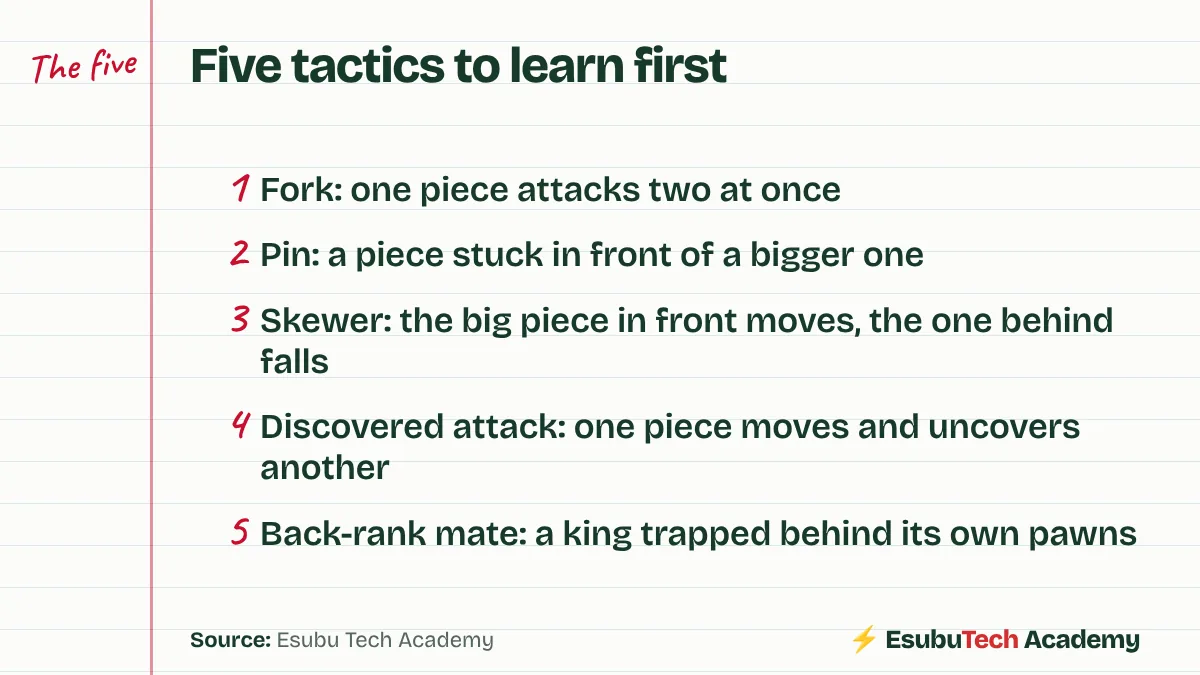
1. The fork
One piece attacks two things at once. Knights fork often, because their jump is the hardest move to see coming.
2. The pin
A piece is stuck because moving it would expose something bigger behind it. When the piece behind is the king, the pinned piece isn’t allowed to move at all.
3. The skewer
The reverse of a pin. The bigger piece stands in front, gets attacked, moves away, and the piece behind it is lost.
4. The discovered attack
One piece moves out of the way and uncovers an attack by the piece behind it. The piece which moves is free to attack something else at the same time.
5. Back-rank mate
A king sits behind its own pawns, with no square to escape to. A rook or queen arrives on the back rank and it’s checkmate.
The last board matters most for children. Once they know the pattern, they start to see it threatening their own king, and one pawn move after castling, such as h3, gives the king a way out.
Ten minutes a day beats one long session
Patterns stick best when practice is spread out. A 2006 review of 317 memory experiments, led by Nicholas Cepeda, found spaced practice beat the same practice crammed into one session, consistently. For your child, ten minutes a day across a week beats seventy minutes on a Saturday.
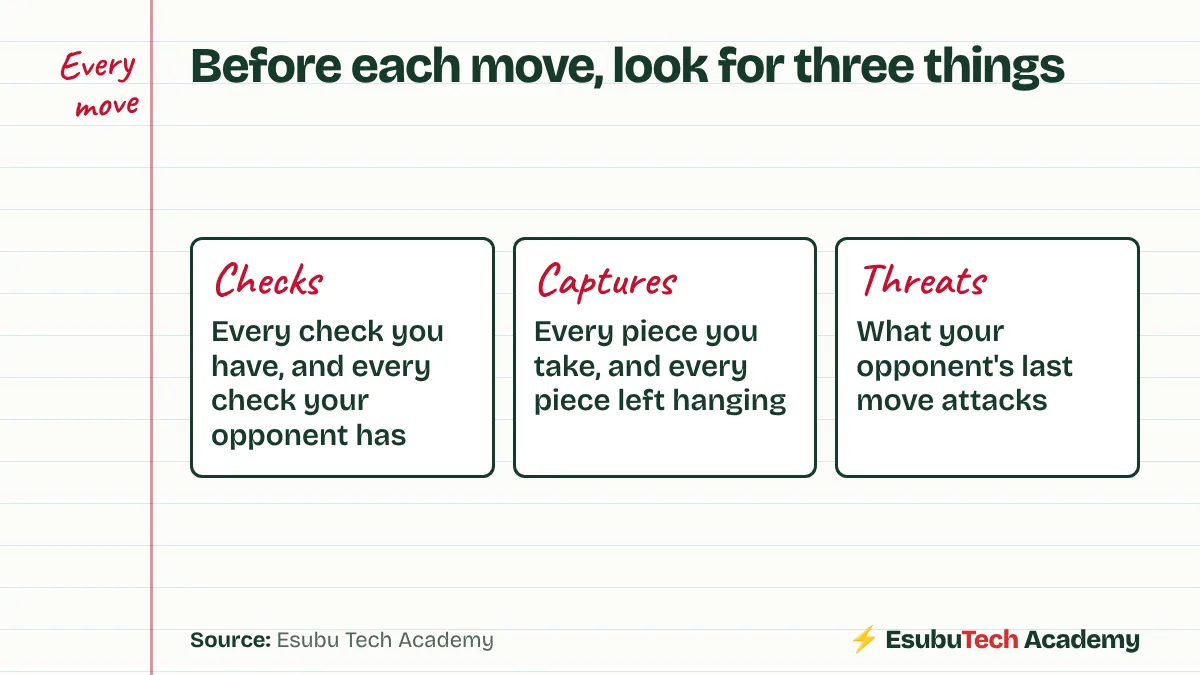
- Pick one theme on the Lichess puzzle themes page, such as forks
- Solve five puzzles from the theme
- Set the hardest one up on a real board and solve it again, saying the move out loud
- Ask your child to name the pattern before you check the answer
Rotate the theme each week. After five weeks, mix them, because in a real game nobody announces which pattern is coming.
Test it yourself
Try the Chase and Simon test at home. Set up a position from one of your child’s real games, show it for ten seconds, then ask them to rebuild it. Do it again in a month, after four weeks of puzzles. Count the pieces placed correctly both times.
The Lichess themes page is free, with no adverts. For the opening moves where many of these tactics first appear, read our post on the Italian Game, and if you’re the one teaching, start with teaching your child chess at home.
Check this yourself
The sources behind this post. Read them, and read the people who disagree, before you decide.
- Chase and Simon, Perception in chess (1973), summary notesStronger players rebuilt real positions better, with no edge on random ones. The chunking idea.
- Distributed practice in verbal recall tasks (Cepeda and colleagues, Psychological Bulletin, 2006)317 experiments. Spaced learning showed benefits over massed learning at every retention interval.
- Puzzle themes (Lichess)Free puzzles sorted by theme: fork, pin, skewer, discovered attack, back-rank mate and more.
- About LichessFree and open source, no adverts.
Sammy founded Esubu Tech Academy and designs its coding and chess curriculum. He holds a BSc in Data Science from KCA University and is studying for an MSc in Artificial Intelligence at the Open University of Kenya. He learned to code as an adult, after years of unfinished tutorials, and teaches children so they start sooner.