The first chess opening to teach your child: the Italian Game, move by move
Knowing how the pieces move is step one. The next step is a plan for the first six moves. The Italian Game gives your child one, with a reason behind every move.

, 4 min read
On this page
Your child knows how every piece moves. They’ve played a few full games. Then a cousin or a classmate does something strange: the queen comes out on move two, a bishop joins on move three, and on move four the game is over. Checkmate in four moves.
Children lose to this trap again and again. It’s called Scholar’s Mate, and it works for one reason: the beginner has no plan for the first moves, so the attacker’s plan wins.
“Learn the rules, then play a lot”
Most of us learned chess this way. Learn the moves, play a lot, and improve by luck. Openings sound like something for serious players with thick books.
Learning by luck has a cost. In the opening, every move either builds something or wastes time. A child without a plan wastes moves, and against anyone with a plan, the game is lost before it starts. Strong players follow ideas they learned once and use every game.
First, stop the four-move mate
After 1.e4 e5 2.Qh5 Nc6 3.Bc4, White’s queen and bishop both aim at the pawn on f7. Only the black king guards it. The threat is Queen takes f7, checkmate.
Teach your child to look at f7 every time the enemy queen and bishop come out early. Pawn to g6 blocks the queen. Queen to e7 guards f7 a second time. Knight to f6, the natural-looking move, loses on the spot.
The Italian Game uses the same aim at f7 as the four-move trap, with a plan behind it instead of a gamble.
The Italian Game in six moves
The Italian Game is one of the oldest openings in chess. It follows every rule a beginner needs.
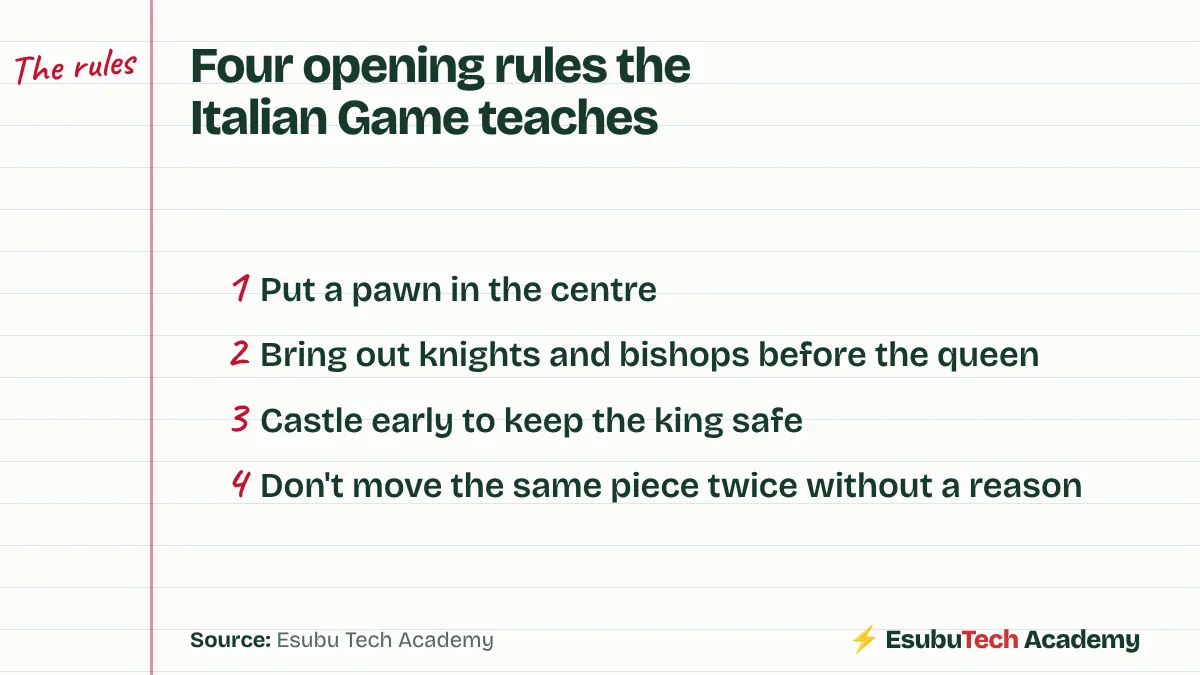
Here are the first three moves for each side, with the reason behind each:
1.e4 e5: both sides put a pawn in the centre, where pieces get the most room. 2.Nf3 Nc6: White’s knight attacks the e5 pawn. Black’s knight defends it. Knights come out before the bishops because they need two moves to reach good squares. 3.Bc4 Bc5: both bishops aim at the weakest squares, f7 and f2, near the enemy king.
Then come three quiet moves:
4.c3 Nf6: White takes control of the d4 square for later. Black’s second knight comes out and attacks e4. 5.d3 d6: each side defends its centre pawn and opens a road for the other bishop. 6.O-O O-O: both kings castle to safety, tucked behind pawns, with a rook coming to the middle.
Six moves in, both sides have a sound position and the real game starts. Your child got there without losing a piece or walking into a trap.
Teach it at the kitchen table
- Play the six moves slowly, saying each reason out loud.
- Swap colours and play them as Black.
- Set up the Scholar’s Mate position and let your child find the defence three times in a row.
- Then play full games starting from move six, so the opening becomes habit.
Check it with your own eyes
Replay the moves on a free site like Lichess and try other replies for Black. Watch what happens when Black ignores a rule, such as moving the queen early. Our post on teaching chess at home in seven days covers the rules first, if your child is new to the board.
An opening teaches a way of thinking about the first ten minutes of the game. A child who knows why each move is played keeps finding good moves when the opponent does something different.
Check this yourself
The sources behind this post. Read them, and read the people who disagree, before you decide.
- Lichess opening explorer and practiceFree chess site to replay these moves and practise against the computer.
- How to teach your child chess at home in 7 days (Esubu Tech Academy blog)The rules and first full game, before this opening.
Sammy founded Esubu Tech Academy and designs its coding and chess curriculum. He holds a BSc in Data Science from KCA University and is studying for an MSc in Artificial Intelligence at the Open University of Kenya. He learned to code as an adult, after years of unfinished tutorials, and teaches children so they start sooner.