Computational thinking explained with ugali, matatus and laundry
The phrase turns up in coding courses and curriculum talk, and most parents nod along. Here it is in plain words, with examples from a Kenyan kitchen.

, 3 min read
On this page
Watch a twelve-year-old cook ugali for the first time without help. Water on the jiko. Flour in too early, then too much at once. Lumps. Panic. Somebody’s mother steps in, and the lesson ends.
Now watch the same child after an older sister walks them through it, step by step, three times. By the fourth evening the child cooks alone, in order, and fixes the lumps without being told. Something changed in how the child thinks about the task.
The change has a name in coding classes: computational thinking.
“It’s a fancy word for using computers”
The phrase sounds technical, so parents assume it means computer skills: typing, using apps, or coding itself.
It doesn’t need a computer at all. The idea became famous through a 2006 essay by Jeannette Wing, a computer scientist, in Communications of the ACM. Her argument: thinking the way computer scientists think is a basic skill for everyone, not only for people who write software.
Many teachers break it into four habits.
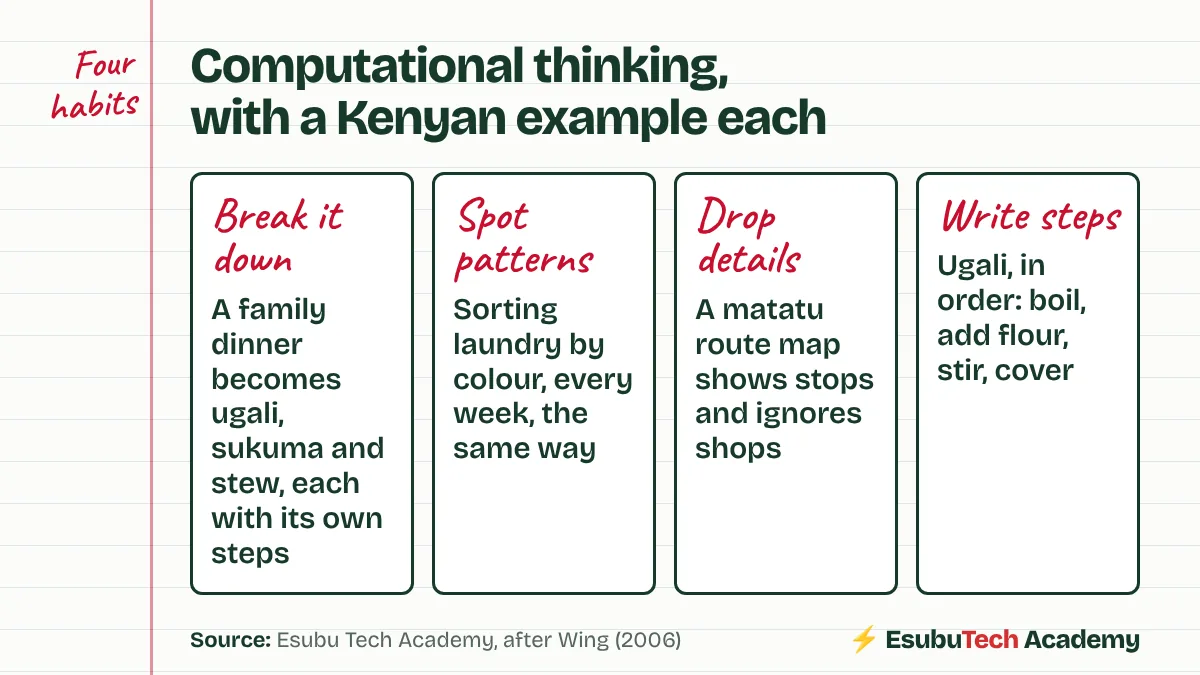
None of these is new to your home. What coding adds is practice: thousands of small chances to use all four, with a computer showing at once whether the thinking worked.
A computer does exactly what it’s told. A child who learns to tell it clearly learns to think clearly.
The four habits, at home
Break it down. A family dinner is too big to cook in one step. Ugali, sukuma and stew each get their own plan, and someone works out what starts first. Children who learn to split a big task stop freezing in front of one.
Spot patterns. Laundry on Saturday follows the same pattern every week: whites, colours, school uniforms. Once a child sees the pattern, the job gets faster and needs no reminder.
Drop details. A matatu route map shows the stops and leaves out the shops, the trees and the potholes. It keeps only what a passenger needs. Programmers call this abstraction, and it’s often the hardest of the four for children, because everything feels important.
Write steps. Ugali, in order: boil the water, add flour slowly, stir hard, cover, turn out. Write the steps down and someone else follows them. Miss one, and the lumps come back. A list of steps in the right order is an algorithm.
Where coding comes in
Build one Scratch game and your child uses all four habits in an afternoon. The game splits into a player, an enemy and a score. The enemy moves in a pattern. The background drops every detail except the walls. And every behaviour is a list of steps the computer follows exactly.
When something goes wrong, the computer shows it at once. The cat walks through the wall. The score never moves. Your child goes back to the steps, finds the missing one, and fixes it. This loop of trying, checking and fixing is the habit we care about most.
Look for it yourself
Read the short Wikipedia entry and the National Centre for Computing Education page below. Then watch your child do one chore this week, and name which of the four habits they used.
Many parents find their child already thinks this way. Coding gives the habits a place to grow. Our post on what age a child should start coding has a screen-free game to try first.
Check this yourself
The sources behind this post. Read them, and read the people who disagree, before you decide.
- Computational thinking (Wikipedia)Jeannette Wing's 2006 essay in Communications of the ACM, and the commonly listed elements.
- Computational thinking (National Centre for Computing Education, Teach Computing)Decomposition, abstraction and algorithmic thinking, as taught in English schools.
- At what age can a child start coding? (Raspberry Pi Foundation)Instruction games and floor robots as a first step, before screens.
Sammy founded Esubu Tech Academy and designs its coding and chess curriculum. He holds a BSc in Data Science from KCA University and is studying for an MSc in Artificial Intelligence at the Open University of Kenya. He learned to code as an adult, after years of unfinished tutorials, and teaches children so they start sooner.