How a Kenyan child gets a FIDE rating, and what the number means
Every serious chess player carries a number. Your child earns their first one in rated tournaments, and the rules changed in 2024. How it works, in plain words.

, 4 min read
On this page
Your daughter comes back from her first big tournament with a question. A girl she played had a number next to her name on the pairing sheet: 1450. Your daughter’s line was blank. “How do I get a number?”
The number is a FIDE rating, the score every serious chess player in the world carries. It tells strangers how strong a player is before a single move. Getting one is simpler than most parents think, and it changed in 2024.
“The rating shows how talented my child is”
Parents often read a rating like an exam result: high means gifted, low means not. Children read it the same way, and some stop wanting to play rated games for fear of a low number.
A rating measures results against other rated players, recently. It says nothing about potential. It moves after every rated game, up after good results, down after bad ones. A ten-year-old’s rating jumps around for years, and it should.
A rating is a record of games played. It rises because a child keeps playing strangers and learning from the losses.
What the rules say
FIDE, the world chess body, rewrote its rating rules from 1 March 2024. The parts a parent needs are short.
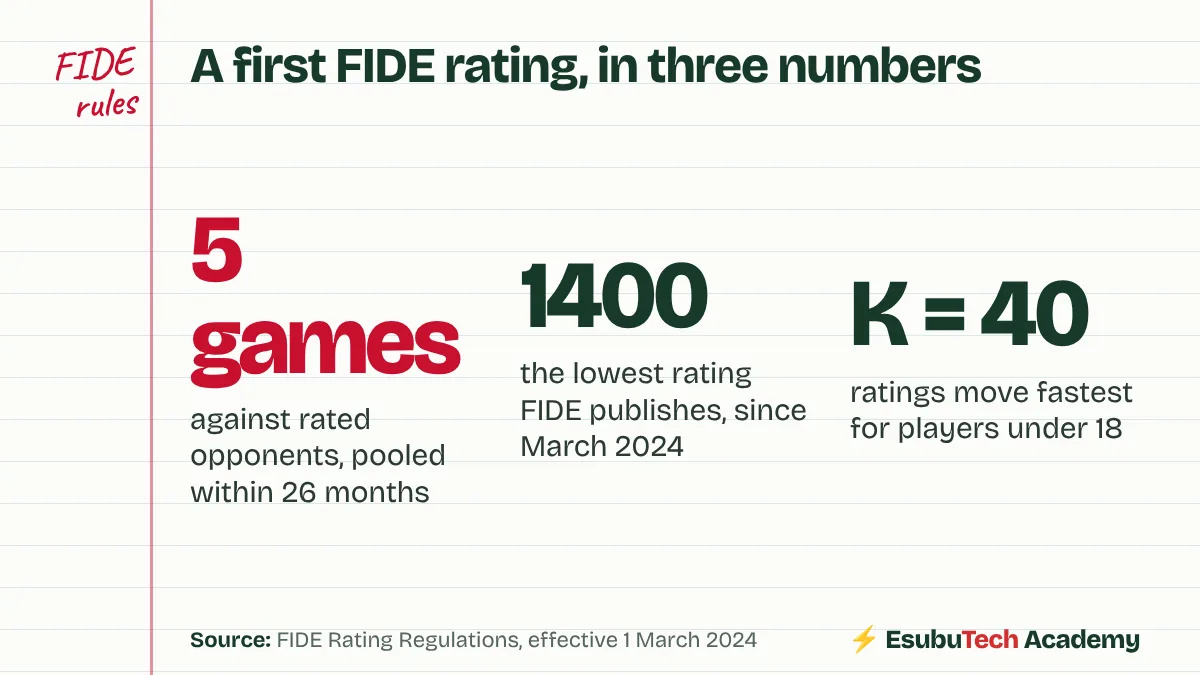
A player new to the list needs at least five games against rated opponents. The games don’t have to come from one tournament. FIDE pools results from consecutive rating periods, as long as they fall within 26 months.
If a new player scores zero in their first rated event, FIDE ignores those results. So a child who loses every game at their first tournament isn’t stuck with a bad first number.
The lowest rating FIDE publishes is 1400. Before March 2024, the floor was 1000. A first rating in 2026 is a bigger step than it used to be.
How the first number is worked out
FIDE takes the average rating of your child’s rated opponents and adds two imaginary opponents rated 1800, each counted as a draw. Then it adjusts the average up or down by your child’s overall score.
Take a worked example. Your child plays five rated opponents averaging 1500 and scores 2.5 points. With the two imaginary draws, the total is 3.5 points from 7 games, exactly half. Half the points means no adjustment, so the first rating is the average: (5 × 1500 + 2 × 1800) ÷ 7, about 1586.
For players under 18, FIDE uses a K-factor of 40, the fastest setting, as long as the rating stays under 2300. Each rated game moves a child’s number more than an adult’s.
The road in Kenya
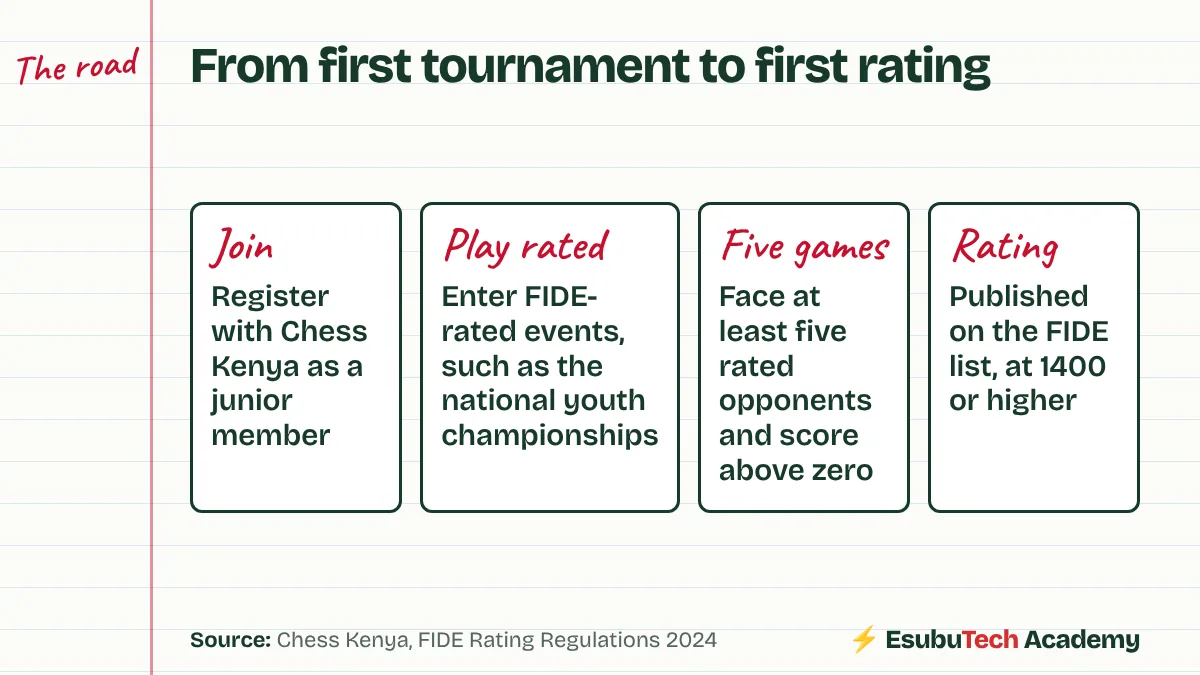
Chess Kenya runs junior membership and lists upcoming events on its website. Its 2026 national youth and cadets championships were FIDE-rated, with sections from under-8 to under-18 and entry through regional qualifiers. Our post on chess tournaments for kids in Kenya walks through the qualifiers.
Before a rated event, check two things with the organisers: is the event FIDE-rated, and does your child need a FIDE ID before the first round? Rules and fees change, so ask each time.
Read the rules, then let the number move
The FIDE regulations are public, and Section 7 and Section 8 cover first ratings. Read them, or ask the tournament arbiter at your child’s next event.
Then help your child treat the number as a record of their games. Celebrate rated games played more than rating points gained. Children who keep playing rated games grow into their numbers.
Check this yourself
The sources behind this post. Read them, and read the people who disagree, before you decide.
- FIDE Rating Regulations, effective 1 March 2024 (FIDE Handbook)Section 7: five games against rated opponents, minimum 1400. Section 8: how a first rating is calculated, and K-factors.
- New FIDE rating and title regulations come into effect (FIDE)The floor rose from 1000 to 1400, with a one-time increase for lower ratings.
- Chess Kenya, frequently asked questionsJunior and senior membership, and the upcoming events list.
- 2026 Kenya National Youth and Cadets Chess Championships (Chess Kenya)FIDE-rated, under-8 to under-18 sections, entry through regional qualifiers.
Sammy founded Esubu Tech Academy and designs its coding and chess curriculum. He holds a BSc in Data Science from KCA University and is studying for an MSc in Artificial Intelligence at the Open University of Kenya. He learned to code as an adult, after years of unfinished tutorials, and teaches children so they start sooner.