A phone for Christmas? What age to give one, and the settings to change on day one
December is when many Kenyan children get their first phone. The age matters, the kind of phone matters, and the settings you change before you hand it over matter most.

, 4 min read
On this page
Walk through any Nairobi phone shop in December and watch the counters. Parents holding a child’s hand. A school leaver choosing a colour. A grandmother buying a smartphone for a ten-year-old because the child asked, and because everyone in the class has one.
If you’re thinking of a phone for Christmas, you’re in good company. Before you buy, look at three things: the age, the kind of phone, and what you set up before your child touches it.
“Every child in the class has one”
This is the sentence parents hear most. It comes with a second one: the school WhatsApp group for homework, and a child who misses messages without a phone.
The pressure is real. So is the cost of giving in early. A team at Sapien Labs studied over 100,000 young adults aged 18 to 24, in 163 countries. They asked when each person got their first smartphone, and measured their mind health today: mood, outlook, drive and resilience.
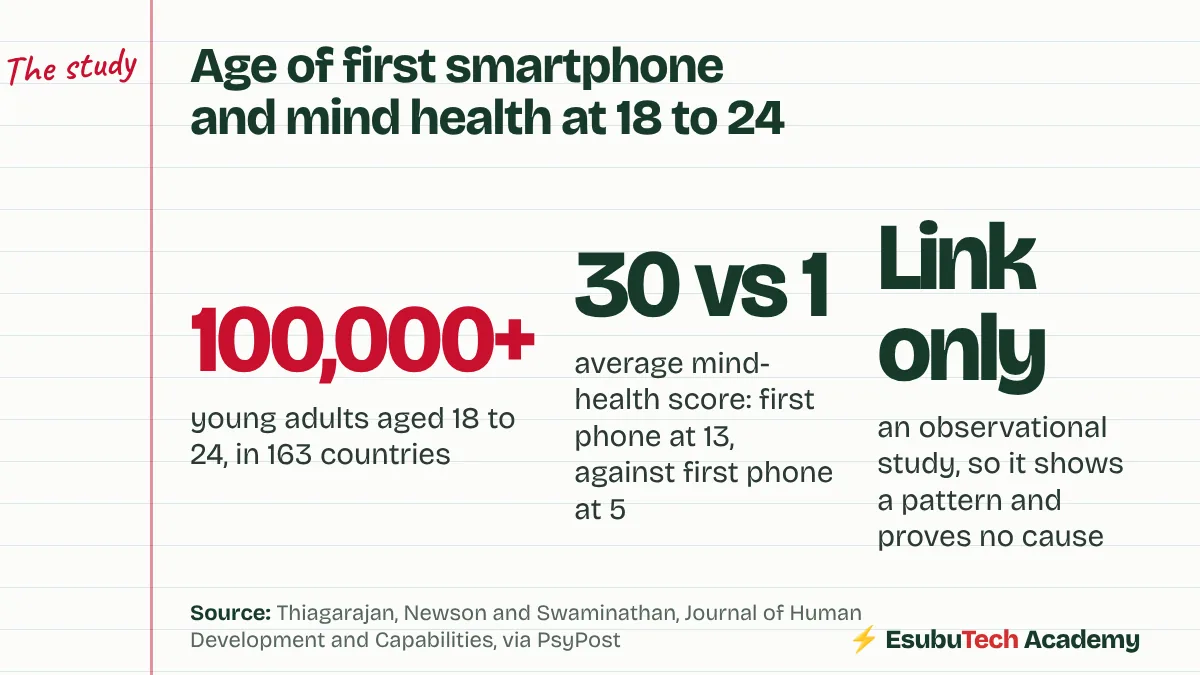
The pattern ran in one direction. The younger the first phone, the lower the mind-health score in young adulthood. People who got a phone at 13 averaged 30 on the scale. People who got one at 5 averaged 1. Early access to social media explained about 40% of the link worldwide, and broken sleep played a part too.
Read the limits before you panic. The study is observational: it shows a pattern across a population, and it doesn’t prove the phone caused anything for any one child. People recalled their childhood ages from memory. It’s still one of the largest studies on the question.
A phone at ten gives your child the world. It also gives the world your child, at ten.
Think about what the phone replaces
Picture your child’s evening a year from now, with the phone. What time does the screen go dark? Who decides? Where does the phone sleep?
Most families never answer these questions out loud. The phone arrives on Christmas morning, and the rules arrive in February, after the first fight. By then the habits are set.
Climb the ladder one step at a time
A child doesn’t need a smartphone to be reachable. A kabambe makes calls, sends SMS and runs M-Pesa. For a child in primary school, it covers almost everything a parent worries about, with nothing to scroll.
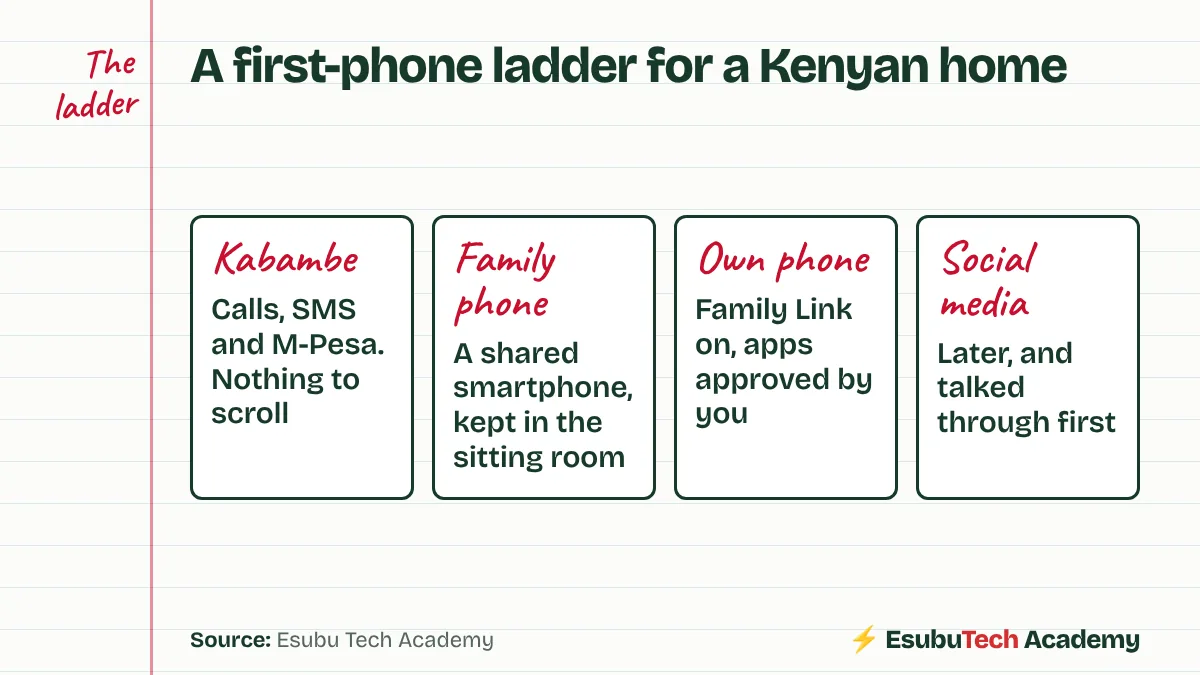
For the homework group, a family smartphone kept in the sitting room works for many households. Your child reads the messages there, in the open.
WhatsApp’s own terms say a person must be at least 13 to register on their own. Use 13 as the floor for your child’s own WhatsApp account, whatever the class does.
Day-one settings, before you wrap it
If a smartphone is the gift, set it up the night before. Every step below costs nothing.
- Create your child’s Google account through Google Family Link, and link it to your phone.
- Set a daily screen time limit and a downtime window, such as 8pm to 6am.
- Turn on app approval, so every new app asks you first.
- In YouTube, use a supervised experience instead of the open app.
- In WhatsApp, go to Settings, then Privacy, then Groups, and choose “My contacts”. People outside your child’s contacts then have to send an invite instead of adding them.
- Agree on where the phone sleeps. A charger in the sitting room settles it.
Ask, then decide
Read the study summary and the Standard’s report with Kenyan parents and teachers, both linked below. Then ask your child’s teacher what the school expects, and whether a shared family phone covers the homework group.
Last, ask your child what they want the phone for. Calls and M-Pesa? Homework? Games? Their answer tells you which step of the ladder fits. And if part of the answer is “to make things”, a phone is the wrong tool. Our post on learning to code on a phone explains why.
Check this yourself
The sources behind this post. Read them, and read the people who disagree, before you decide.
- Getting a smartphone before age 13 linked to worse mental health in young adulthood (PsyPost)Over 100,000 young adults in 163 countries. Observational, with recall of childhood ages.
- Early smartphone use linked to anxiety and mental health risks among children (The Standard, July 2026)Kenyan parents, teachers and a child psychologist on early phones.
- WhatsApp Terms of ServiceAt least 13 to register on your own, or older where local law says so.
- Google Family LinkScreen time limits, app approval, location and content filters for children's accounts.
Sammy founded Esubu Tech Academy and designs its coding and chess curriculum. He holds a BSc in Data Science from KCA University and is studying for an MSc in Artificial Intelligence at the Open University of Kenya. He learned to code as an adult, after years of unfinished tutorials, and teaches children so they start sooner.