Free coding for kids in Kenya: what's out there, and where free runs out
Everything a child needs to learn to code sits online for free. So why do so many children start, and so few finish?

, 4 min read
On this page
I know this story from the inside. For years I worked in tech and tried to learn to code from free courses and videos. I started dozens. I finished almost none. A folder of half-done tutorials followed me from laptop to laptop, until I went back to university to learn properly, as an adult.
The lessons were never the problem. They were free, good, and everywhere. Something else was missing.
What’s free, and good
Start here before you pay anyone. Each of these costs nothing but data.
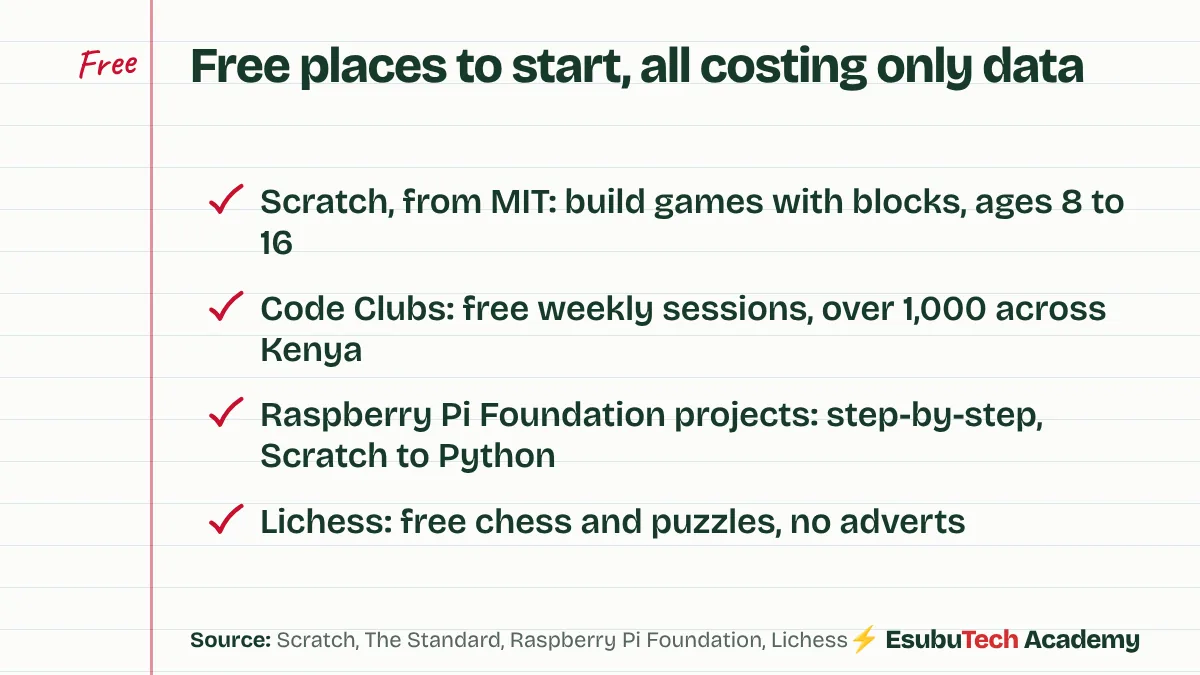
Scratch, made at MIT, lets a child build games and animations by snapping blocks together. It’s designed for ages 8 to 16 and runs on the Scratch website.
Code Clubs run free weekly coding sessions in schools and community spaces. The Raspberry Pi Foundation reports over 1,000 clubs in Kenya, in 40 of the 47 counties. Ask your child’s school if it hosts one.
The Raspberry Pi Foundation also publishes step-by-step projects, from first Scratch games up to Python.
Lichess gives free chess games and puzzles, with no adverts.
A determined child with a laptop, home Wi-Fi and one of these has everything needed to learn.
“If it’s free online, my child will learn it alone”
Some children do. Most don’t, and the reason has little to do with talent.
Free lessons give knowledge. They don’t give a plan, someone watching, or a reason to come back on the hard week. A child who meets their first stubborn bug on a Wednesday evening, alone, closes the laptop. Nobody notices. Next week there’s football. The project sits half-built, like my folder of tutorials.
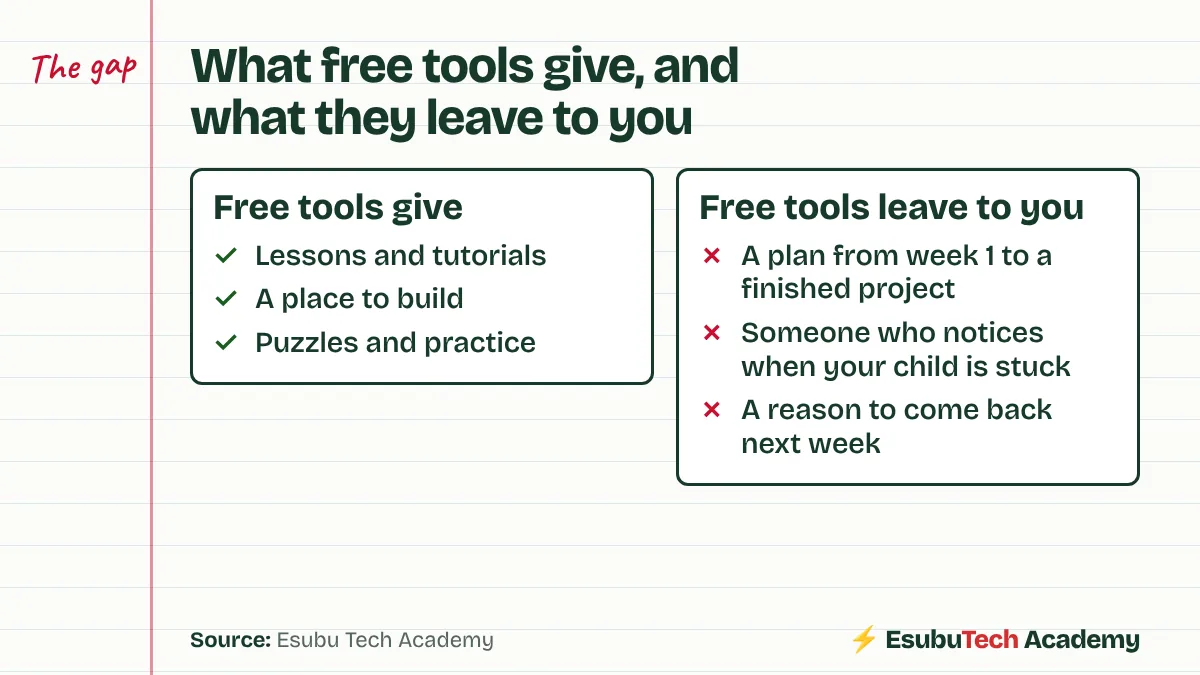
Finding lessons takes five minutes. Noticing the week your child gets stuck, and quietly stops, takes a person.
What I spend my time on
Coding knowledge is free. What I sell is the structure around it. I spend hours testing each lesson on children and cutting it down until they get it, then putting the lessons in an order where each week rests on the last. Before the coding starts, we work on the maths underneath it. I call it preparing the soil.
The finished project is the point. A child who finishes one game knows they finish things. A child with ten half-games learns the opposite lesson.
Why there are no free trial classes here
Many coding schools offer a free trial class. We don’t.
A free hour shows you a child on day one, excited by something new. It doesn’t show you week three, when the project gets hard and the real learning starts. The work worth judging happens there.
So we run like school. You apply, I place your child in the right group, and they start. Fees are monthly, by M-Pesa. If you’d rather see how it goes before committing to a month, ask me on WhatsApp about paying week by week.
Make free work at home
If you go the free route, and many families should, give it the structure yourself:
- One fixed slot, twice a week, written on the calendar
- One project to finish before starting another
- Sit with your child for the first ten minutes of every session
- Ask them to show you the project every Friday
- Join a Code Club if one runs nearby
Test it yourself
Give the free route four weeks with the structure above. Watch what happens in week three. If your child pushes through, keep going, and you’ve saved money. If the project stalls and nobody notices for a fortnight, you’ve learned what your child needs, and it isn’t more lessons.
Our post on nine questions to ask before you pay for a coding class helps when you get there.
Check this yourself
The sources behind this post. Read them, and read the people who disagree, before you decide.
- Scratch, information for parents (MIT)Designed for ages 8 to 16.
- Kenya's Code Clubs hit 1,000 as schools embrace coding (The Standard)Free weekly clubs in 40 of Kenya's 47 counties, run with the Raspberry Pi Foundation.
- At what age can a child start coding? (Raspberry Pi Foundation)Their free paths, from Scratch to Python.
- About LichessFree, open source, no adverts.
Sammy founded Esubu Tech Academy and designs its coding and chess curriculum. He holds a BSc in Data Science from KCA University and is studying for an MSc in Artificial Intelligence at the Open University of Kenya. He learned to code as an adult, after years of unfinished tutorials, and teaches children so they start sooner.