Grade 10 Computer Science in Kenya: what your child will learn, and how to prepare from Grade 7
We read KICD's own curriculum design for Grade 10 Computer Science. Half the subject is programming, and a child in Grade 7 today has time to prepare.

, 3 min read
On this page
Ask a parent what Computer Studies means and you’ll hear about typing, Microsoft Word and the parts of a computer. The subject looked like this for many of us: a lab with old machines, a teacher reading out the names of keyboard keys, an exam about the CPU.
Grade 10 Computer Science, as KICD designed it for senior school, looks different. We read the curriculum design itself, the document teachers plan from.
“Computer lessons are about using a computer”
Most parents expect their child to learn to use software. The design spends most of its time on making it.
It splits the year into three strands, with a suggested number of lessons for each.
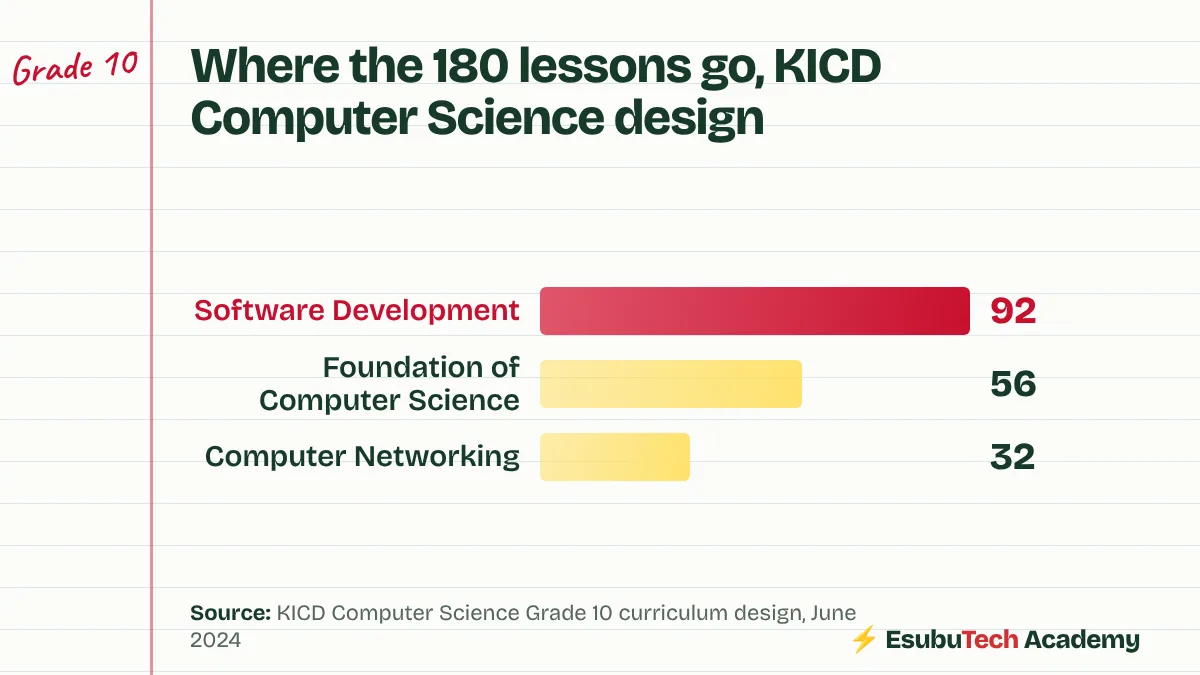
Software Development takes 92 of the 180 suggested lessons, a little over half. Its sub-strands read like a first programming course: computer programming concepts, program development, identifiers and operators, control structures, containers and functions. The other strands cover how computers and networks work, from the CPU and operating systems to network topologies.
The design lists the languages learners write programs in. The list includes Python, C, C++, Java, Swift and Go. It also includes Scratch.
Grade 10 Computer Science spends half its lessons on writing programs. A child who meets programming for the first time in Grade 10 starts behind a child who met it in Grade 7.
What a child in Grade 10 writes
Take one sub-strand, control structures: making a program choose between paths. In Grade 10 it might look like this, in Python:
score = 7
if score >= 5:
    print("You pass this level")
else:
    print("Try again")
A nine-year-old in Scratch writes the same idea with blocks:
The idea is identical: check a condition, then act. The Grade 10 version adds typing, exact spelling and indentation. A child who has built ten Scratch games arrives already knowing the idea, and only has to learn the new way of writing it.
Not every school offers it
Ask early which senior schools near you offer Computer Science, or Computer Studies, as some lists call it. The Kenya Times reported the combination with Mathematics and Physics runs only in schools approved for it. Choosing a school without the subject closes the door for all three years of senior school.
A preparation plan, Grade 7 to Grade 9
- Grade 7: Scratch projects at home, one finished game a term. Learn to type with both hands.
- Grade 8: harder Scratch projects with scores, levels and lists. Start Python basics: printing, variables, “if”.
- Grade 9: small Python programs: a quiz, a calculator, a guessing game. Keep maths strong, because placement into STEM leans on it.
Read the design yourself
The KICD design is a public PDF, linked below. Open it and read the Software Development strand. Then ask the senior schools on your child’s list two questions: do you offer Computer Science, and how many learners share a computer in the lab?
The answers tell you more than any brochure. Our post on preparing for the STEM pathway covers the rest of the placement picture.
Check this yourself
The sources behind this post. Read them, and read the people who disagree, before you decide.
- Computer Science Grade 10 curriculum design (KICD, June 2024)Strands, sub-strands, suggested lessons, and the list of languages learners may use.
- Grade 10 school finder: schools offering Mathematics, Computer Studies and Physics (Kenya Times)The combination runs only in schools approved for it.
- Scratch, information for parents (MIT)Free, in the browser, designed for ages 8 to 16.
Sammy founded Esubu Tech Academy and designs its coding and chess curriculum. He holds a BSc in Data Science from KCA University and is studying for an MSc in Artificial Intelligence at the Open University of Kenya. He learned to code as an adult, after years of unfinished tutorials, and teaches children so they start sooner.