Over 600,000 Grade 9 learners chose STEM. Is your child ready for it?
Choosing STEM takes one tick on a form. Qualifying for it starts years earlier, in habits most homes never look at.

, 4 min read
On this page
In December 2025, over a million Grade 9 learners got their first KJSEA results. At the bottom of each slip sat a line many families had argued about at dinner for months: the pathways the learner qualified for.
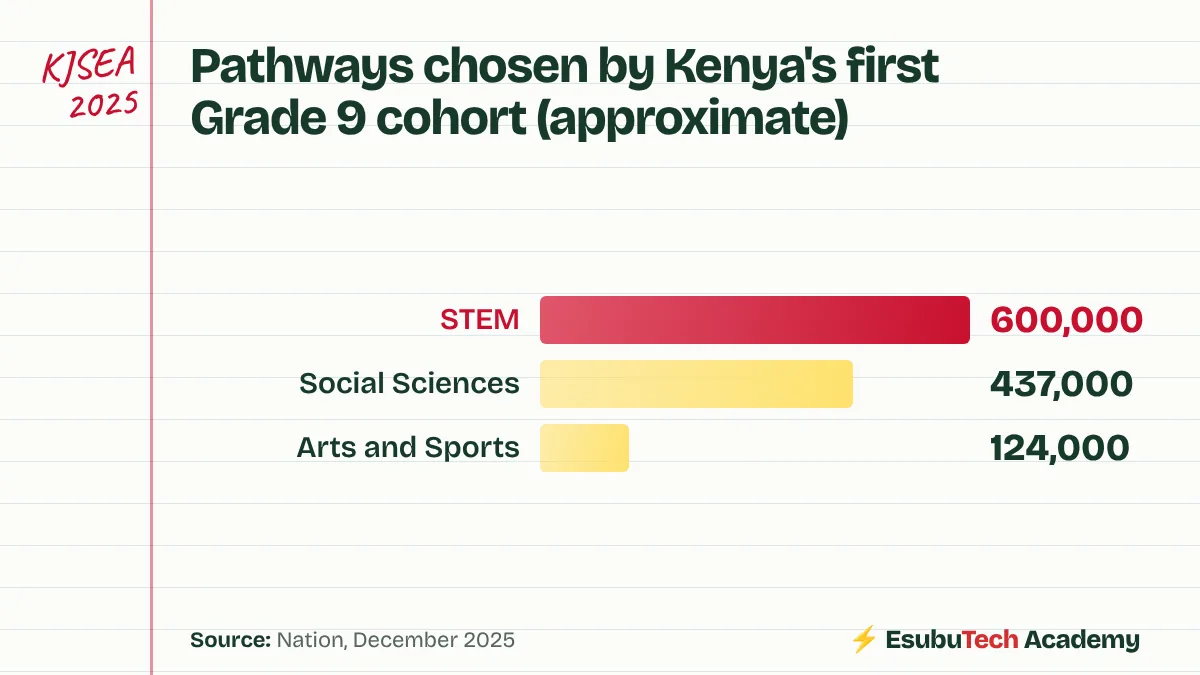
The choices came in lopsided. According to the Nation, more than 600,000 learners chose STEM. About 437,000 chose Social Sciences, and about 124,000 chose Arts and Sports.
Parents want STEM. So does the government. The Centre for Mathematics, Science and Technology Education in Africa says Kenya aims for 60% of senior school learners in STEM pathways.
The tick on the form
The belief behind many of those choices goes like this. My child picks STEM, so my child gets STEM.
Placement doesn’t work like a menu. KNEC looked at the scores in the subjects linked to each pathway, converted to standard scores, and set a minimum for each one. STEM had its own minimum. A learner who chose STEM without the scores behind it did not qualify for it, whatever the form said.
And the scores tell a hard story. In the same results, only 32.44% of Grade 9 learners met or exceeded expectations in Mathematics. It was the weakest subject apart from Kenyan Sign Language.
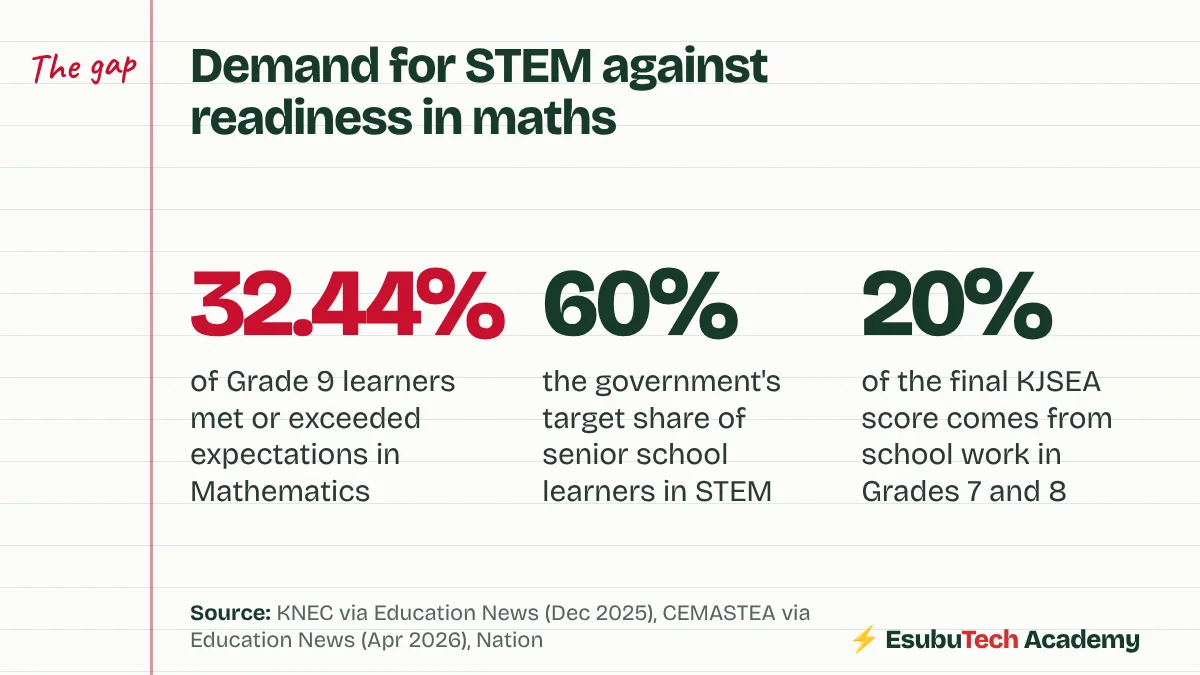
Put those two numbers side by side. More than half the cohort wants STEM. About a third met the maths mark.
Choosing STEM takes one tick. Being ready for STEM takes years of small habits.
What Grade 10 STEM asks of a child
Picture your child in a STEM classroom in Grade 10. The subject list includes Mathematics, Physics, Chemistry, Biology and Computer Studies, and some schools add technical subjects. Computer Studies with Mathematics and Physics runs only in schools the Ministry approves for it.
Each of these subjects rests on the same few habits:
- Breaking a big problem into small steps, in the right order
- Checking an answer instead of hoping
- Staying with a problem for twenty minutes when the first idea fails
- Reading a diagram, a graph or a table without panic
None of these habits appears for the first time in Grade 10. They grow from Grade 4 onwards, at the homework table, in games, in the way a child handles getting stuck. By the time the pathway form arrives, most of the work is already done, or missing.
There is a second detail worth knowing. The final KJSEA score is not one exam. According to the Nation, it combines 20% from the Grade 6 KPSEA, 20% from school-based assessments in Grades 7 and 8, and 60% from the Grade 9 assessment. Work your child does in Grade 7 counts toward the pathway.
What to build, grade by grade
Grades 4 to 6 are for number sense and stamina. Talk maths at home every day: the change from an M-Pesa payment, the fare to town for four people, half a recipe. Give your child puzzles which take longer than five minutes. A first coding tool like Scratch fits here, because a program which doesn’t work forces a child to find the mistake.
Grades 7 and 8 are where the record starts. Ask the school for your child’s school-based assessment results every term, subject by subject. A below-expectation mark in Integrated Science or Mathematics in Grade 7 is a warning you still have two years to act on.
In Grade 9, ask early which senior schools near you offer the subject combinations your child wants. Not every STEM school offers Computer Studies.
Talk about careers before the form, too. A child who knows why they want STEM works harder for the scores. Our post on the jobs growing fastest by 2030 is a place to start the conversation.
Check the criteria yourself
Pathway rules are new, and they will change as KNEC and the Ministry learn from the first cohort. The numbers above come from news reports of the first placement, and the learner counts are approximate. Read the Nation’s account of the placement criteria, then ask your child’s school how they guide learners through the choice.
Ask one more question, of yourself. Does your child want STEM, or do you want it for them? Both answers are fine. They lead to different conversations at home.
STEM in Grade 10 rewards the child who has practised thinking in steps for years. Start the practice now, whatever grade your child is in.
Check this yourself
The sources behind this post. Read them, and read the people who disagree, before you decide.
- KJSEA: Inside criteria for placing learners in senior schools (Nation, December 2025)Placement by z-scores of pathway subjects, minimum scores, and the 20/20/60 make-up of the final score.
- Mathematics, Kenyan Sign Language post lowest scores in 2025 KJSEA results (Education News)32.44% met or exceeded expectations in Mathematics.
- Govt targets 60% STEM enrolment in senior schools (Education News, April 2026)CEMASTEA on the 60% STEM goal.
- Grade 10 school finder: schools offering Mathematics, Computer Studies and Physics (Kenya Times)The combination runs only in schools approved by the Ministry.
Sammy founded Esubu Tech Academy and designs its coding and chess curriculum. He holds a BSc in Data Science from KCA University and is studying for an MSc in Artificial Intelligence at the Open University of Kenya. He learned to code as an adult, after years of unfinished tutorials, and teaches children so they start sooner.