The jobs growing fastest by 2030, and what developers earn in Kenya
Your child's first job is ten or fifteen years away. Some jobs on today's list will shrink by then. A handful are growing fast.

, 4 min read
On this page
Ask a ten-year-old what they want to be. You will hear the classic answers: doctor, pilot, lawyer, engineer. Some will say YouTuber. Few will name a job from the list below, because nobody they know does it yet.
The World Economic Forum asks employers around the world which jobs they expect to grow and which to shrink. Its 2025 report looks ahead to 2030. It expects about 170 million jobs created and about 92 million displaced worldwide in five years.
Among the fastest-growing roles, it names these:
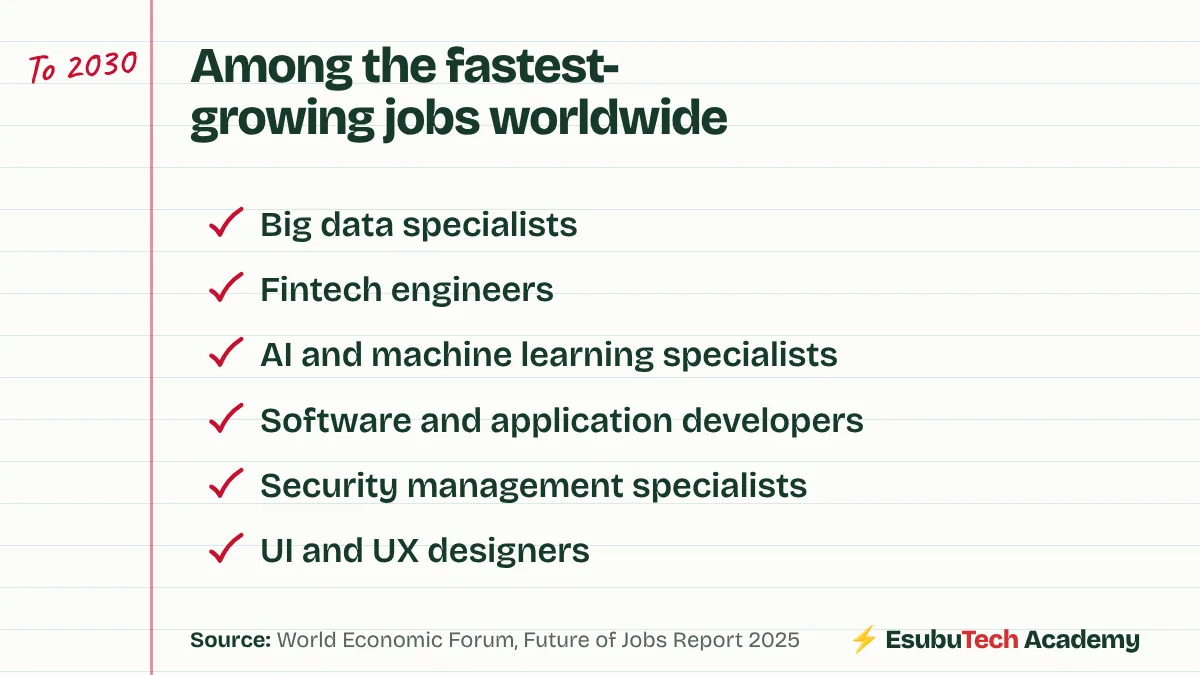
Two of these jobs already sit inside your phone. Fintech engineers build systems like M-Pesa, which Safaricom launched in Kenya in 2007, and security specialists keep it from being robbed. Your child has never known a Kenya without mobile money. Somebody their age will build whatever replaces it.
Among the fastest shrinking, it names cashiers and ticket clerks, administrative assistants and executive secretaries, and accountants and auditors. Graphic designers sit close behind, outside its top ten.
“A good degree is the safe road”
Most Kenyan families share one plan. Work hard, get a C+ in KCSE, get a degree, get a job.
Look at the first step. In the 2025 KCSE, 993,226 candidates sat the exam. 270,715 reached C+ and above, the grade for direct university entry. About 27 in every 100. More than 359,000 scored D or below.
Then look at the last step. A degree in a shrinking field leads to a crowded queue. A degree in a growing field still needs skills the degree alone doesn’t give: building things, solving problems no textbook covers, learning a new tool every year.
The safe road has more traffic on it every year.
What the growing jobs pay in Kenya
The best numbers I found come from two sources. Treat them as estimates.
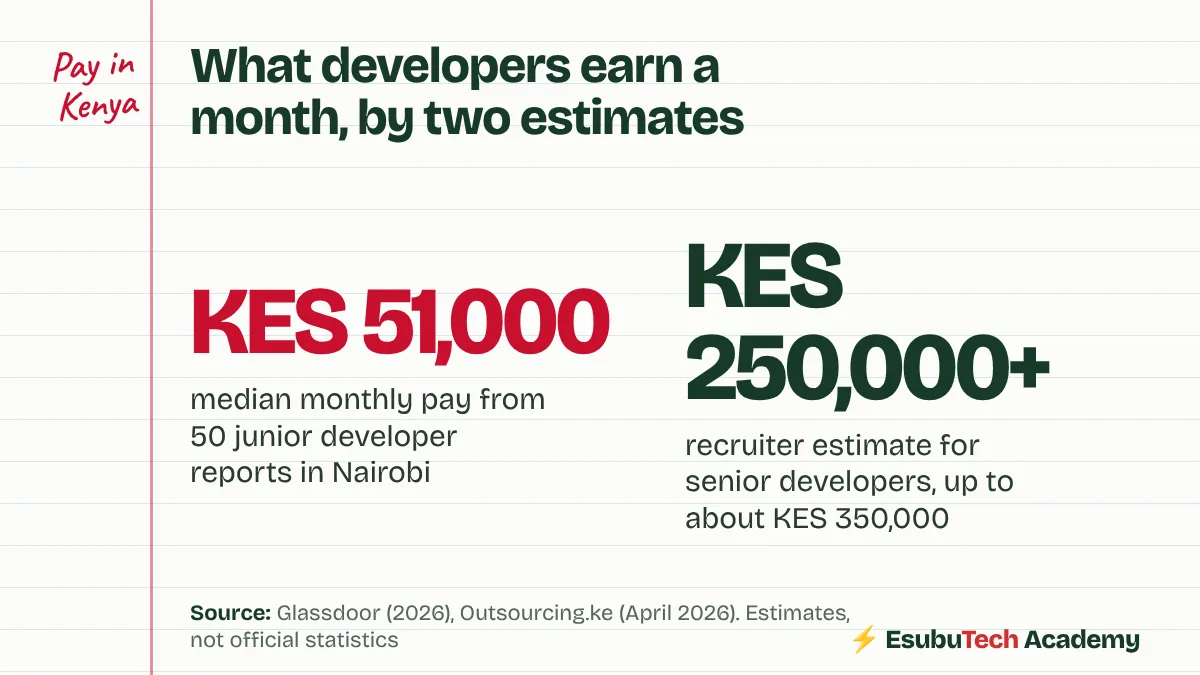
On Glassdoor, 50 junior developers in Nairobi reported monthly pay between about KES 30,000 and KES 100,000, with a median around KES 51,000. A Kenyan outsourcing firm estimates KES 60,000 to 100,000 for juniors and KES 250,000 to 350,000 for senior developers.
These numbers come from self-reports and recruiter estimates, not official statistics. Pay depends on the company, the skill and the person.
The jobs growing fastest share one trait: the person tells the computer what to do, and checks whether it did it right.
The skill behind the job titles
Job titles change every few years. Some of the jobs your child applies for in 2040 will carry names nobody uses yet.
The skills underneath change much more slowly. Every job on the growing list asks a person to:
- Break a messy problem into steps a computer follows
- Use maths without fear: percentages, graphs, rough estimates
- Write clearly, because code and data mean nothing until someone explains them
- Learn a new tool without waiting for a teacher
- Finish things, then fix them when they break
A ten-year-old practises every one of these when they build a game, lose at chess and replay the game, or explain to you why their answer is right.
Do your own research
Read the WEF report’s jobs chapter. It is long, and the employers it surveyed are global, so Kenya’s picture differs. Then find a working developer, data analyst or cybersecurity person, on LinkedIn or in your family, and ask them what they wish they had learned at twelve.
Ask your child the question again too, after showing them the list. Watch which job makes them ask “what does this person do all day?”
Their answer is a better guide than any salary table.
Check this yourself
The sources behind this post. Read them, and read the people who disagree, before you decide.
- Future of Jobs Report 2025, jobs outlook (World Economic Forum)About 170 million jobs created and 92 million displaced by 2030, worldwide.
- Junior Software Developer salaries in Nairobi (Glassdoor)Self-reported pay, 50 reports. Monthly total pay KES 30,000 to 100,000, median about KES 51,000.
- Software developer salary in Kenya 2025/26 (Outsourcing.ke)Indicative ranges: junior KES 60,000 to 100,000 a month, senior KES 250,000 to 350,000.
- 359,144 candidates scored D and below in the 2025 KCSE (The Star, 9 January 2026)993,226 candidates, 270,715 at C+ and above.
Sammy founded Esubu Tech Academy and designs its coding and chess curriculum. He holds a BSc in Data Science from KCA University and is studying for an MSc in Artificial Intelligence at the Open University of Kenya. He learned to code as an adult, after years of unfinished tutorials, and teaches children so they start sooner.