Should your daughter learn to code? What Kenya's Grade 9 results suggest
In Grade 9, Kenyan girls outperformed boys in most subjects. In university computer science classes they're a small minority. Something happens in between.

, 3 min read
On this page
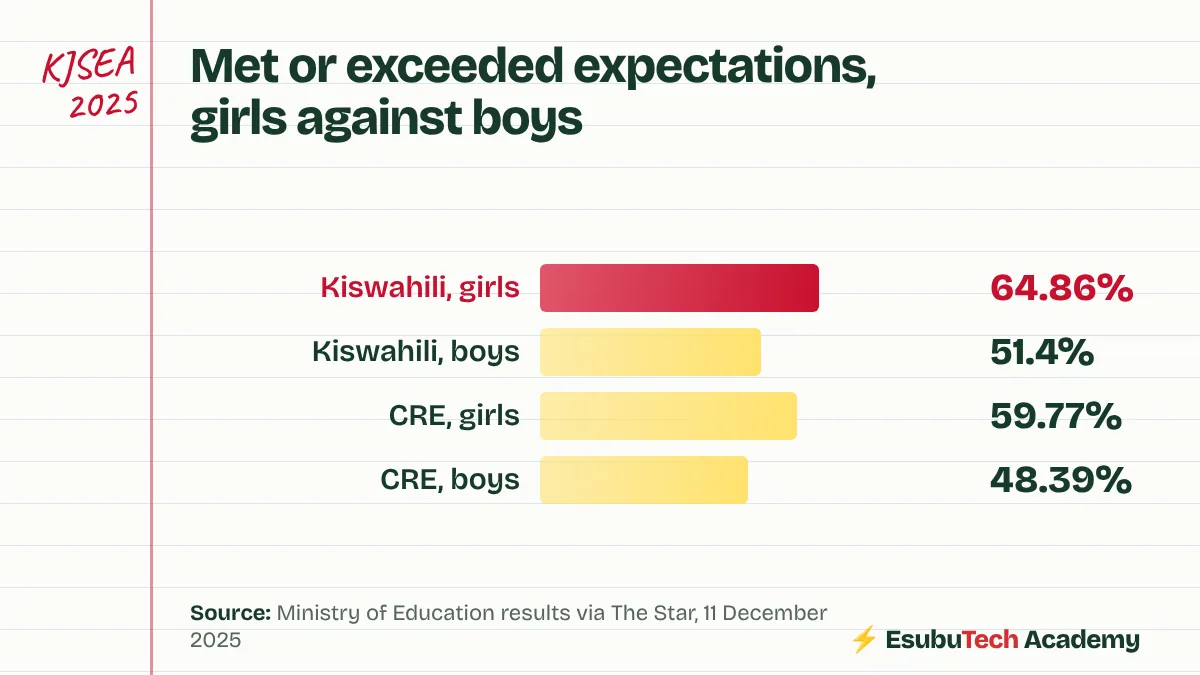
When the 2025 KJSEA results came out, the Ministry of Education announced a line many parents of daughters smiled at. Girls met or exceeded expectations in 10 of the 12 subjects, ahead of boys.
The gaps were wide in places. In Kiswahili, 64.86% of girls met or exceeded expectations, against 51.4% of boys. In CRE, 59.77% against 48.39%.
Now jump ahead a few years, to a university computer science lecture. Anthony Luvanda, a senior lecturer who writes for Brookings, reported women made up less than 9% of computer science students at his university. A Boston Consulting Group study of Africa’s 4.7 million developers found women vastly underrepresented. The highest share in any African country was 24%, in Tunisia.
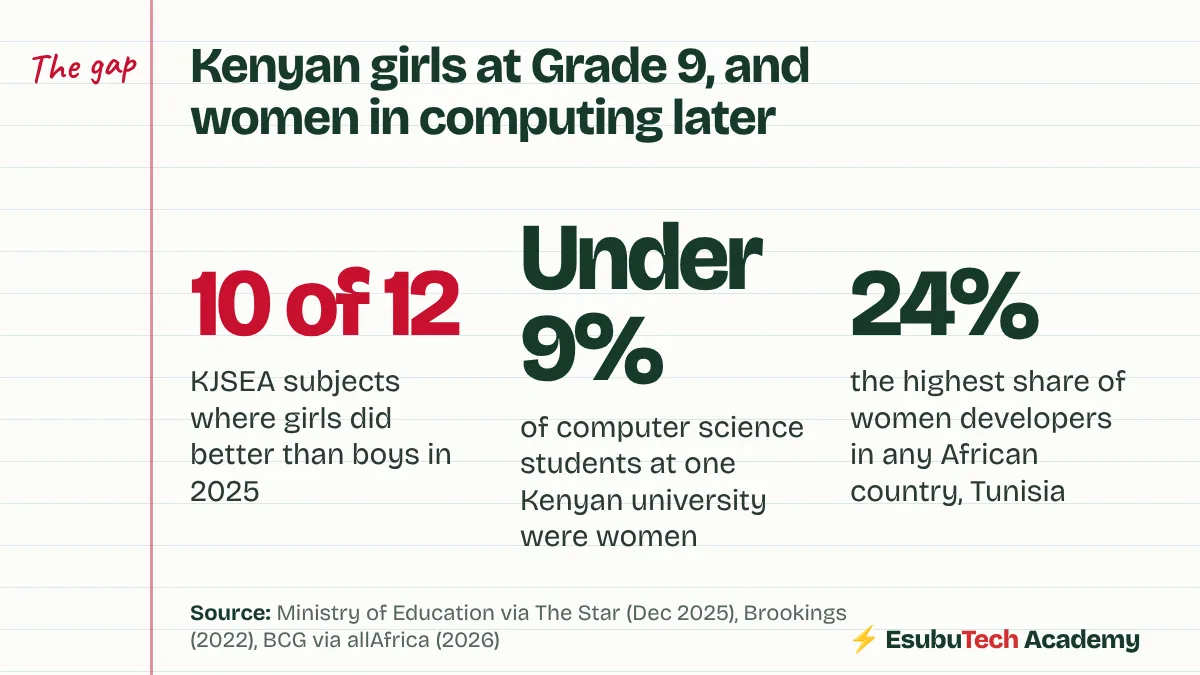
Ahead in most subjects at 14. A small minority in computing at 20. Something happens in between.
“Girls aren’t into computers”
Most people who say this mean it kindly. Girls like other things. Let them follow their interests.
The Grade 9 results don’t show girls who struggle with hard subjects. Ability isn’t the problem. Researchers call the drop-off a leaky pipeline: at every stage, a few more girls step away from computing, until few remain.
Each leak looks small and natural from inside a family. Nobody decides to steer a girl away from technology. It happens in a hundred small moments.
Nobody tells a girl to stay away from computers. They hand the laptop to her brother first.
Look at your own house
Answer these honestly.
Who in your home sets up the new phone, or fixes the Wi-Fi when it drops? Who gets the laptop first when two children want it? When something electronic breaks, who is invited to open it and look inside?
Who does your daughter see working in technology? A woman in a family, on TV, at church? If she has never seen one, she has no picture of herself in the job.
None of these questions is about talent. All of them shape what a twelve-year-old believes she’s allowed to be good at.
What helps
- Give her the technical jobs at home: setting up devices, fixing settings, installing apps
- Share the laptop time fairly, on a written schedule
- Let her break things and fix them without rescue
- Find her a group where girls code alongside boys, or with other girls
- Look for women in tech in your network and ask one to talk to her for twenty minutes
Chess offers a quiet example. Kenya’s national youth chess championships run separate girls’ sections in every age group. A girl who sees other girls at the board stops asking whether she belongs there.
Check the numbers yourself
The KJSEA gender figures come from news reports of the Ministry’s announcement, and different outlets rounded some numbers differently. The university figure comes from one lecturer’s institution, not a national count. Read the Brookings article. It names the barriers in detail, and some will look familiar.
Then ask your daughter what she thinks people who build apps look like. Her answer tells you where the pipeline in your house stands.
Our post on the jobs growing fastest by 2030 is a good one to read together.
Check this yourself
The sources behind this post. Read them, and read the people who disagree, before you decide.
- Girls outshine boys in 2025 KJSEA results (The Star, 11 December 2025)Girls met and exceeded expectations in 10 of 12 subjects.
- Girls dominate KJSEA 2025, outshine boys in 10 subjects (Capital FM)The same finding, with subject figures.
- Can digital technology education improve gender equality in ICT careers in Kenya? (Brookings, 2022)Anthony Luvanda: under 9% of computer science students at his university are women, and the leaky pipeline.
- Africa's 4.7 million developers and the gender gap (allAfrica, reporting BCG)Women vastly underrepresented. Tunisia highest at 24%.
Sammy founded Esubu Tech Academy and designs its coding and chess curriculum. He holds a BSc in Data Science from KCA University and is studying for an MSc in Artificial Intelligence at the Open University of Kenya. He learned to code as an adult, after years of unfinished tutorials, and teaches children so they start sooner.