How to write chess notation: a parent's guide to the scoresheet at Kenyan junior tournaments
At a rated tournament, the arbiter hands your child a scoresheet before the first move. A child who has never written a game down meets two new things at once: a tournament and a pen.

, 4 min read
On this page
The tournament hall goes quiet. Clocks sit beside every board. The arbiter walks down the rows handing out sheets of paper with two columns, White and Black, and numbered lines down the side. Your daughter looks at hers, then at you through the doorway.
She knows how to play. Nobody told her she’d have to write the game down as well.
“Notation is paperwork for serious players”
Many parents see the scoresheet as admin, something for adults at big events. Children see it the same way: a chore which eats clock time and gets in the way of the game.
The Laws of Chess see it differently. FIDE’s Article 8.1.1 says each player must record their own moves and their opponent’s, in algebraic notation, on the scoresheet the event provides. Article 8.2 says the scoresheet must stay visible to the arbiter for the whole game. At the end, under Article 8.7, both players sign both sheets to confirm the result.
In a FIDE-rated standard game, notation is part of playing. A child who has never practised it spends attention on the pen which belongs on the board.
The scoresheet is your child’s memory of the game. Without it, a loss teaches nothing, because nobody remembers how it happened.
How the board gets its names
Every square has a name. The columns, called files, are lettered a to h from White’s left. The rows, called ranks, are numbered 1 to 8 from White’s side. So the square in the bottom-left corner, from White’s view, is a1, and White’s king starts on e1.
Each piece has a capital letter. A knight is N, because K is already the king. Pawns get no letter at all: a pawn moving to e4 is written e4.
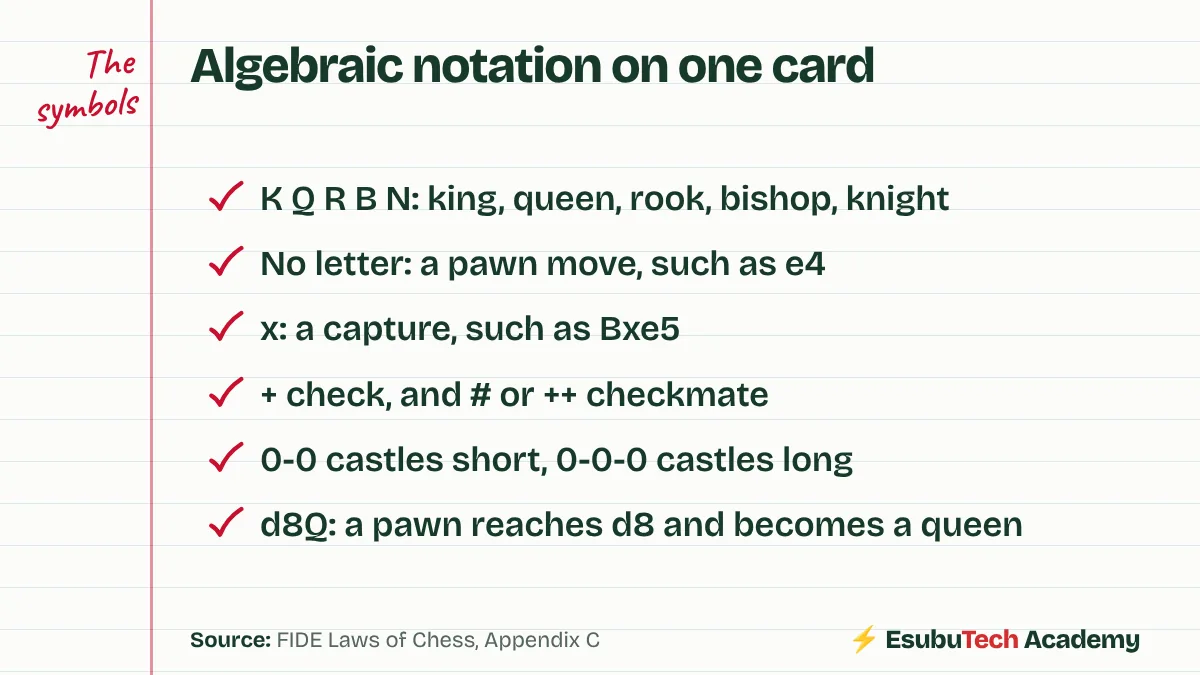
FIDE’s Appendix C writes castling with zeros, 0-0 and 0-0-0. Many books use the letter O instead. The Appendix also allows players to use the piece letters common in their own country.
Writing one move
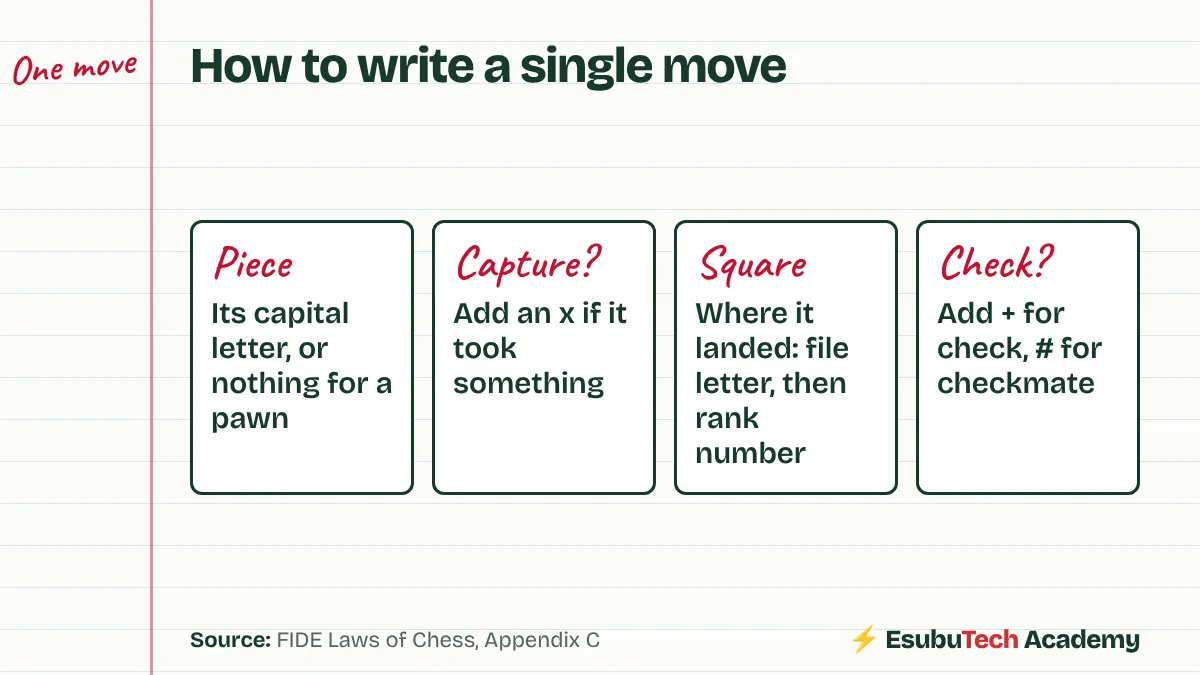
Take a short game children meet early, sometimes on the losing side. White aims the queen and bishop at the weakest square in Black’s camp, f7.
On the scoresheet, the whole game looks like this:
| Move | White | Black |
|---|---|---|
| 1 | e4 | e5 |
| 2 | Bc4 | Nc6 |
| 3 | Qh5 | Nf6 |
| 4 | Qxf7# |
Read the last line aloud with your child: queen takes on f7, checkmate. Four letters and a symbol hold the whole story of the game.
Three rules children trip on
Write after you move, never before. Article 8.1.2 forbids recording moves in advance, apart from a few draw claims. A child who writes the move first, then changes their mind, has broken the rule even with good intentions.
Write both players’ moves. Children often forget the opponent’s move while thinking about their own reply. The habit to build: opponent moves, write it, then think.
Know the five-minute exception. Under Article 8.4, a player with less than five minutes left, in a game without an increment of 30 seconds or more per move, doesn’t have to keep recording for the rest of the period. Rapid and blitz events follow different rules again, so ask the organisers what applies in your child’s section.
Practise at home before the tournament
Play a game at home where both of you write every move. Then swap sheets and try to replay the game from the other person’s sheet. Wherever the replay breaks, one of you wrote a move wrong. Finding the line is a lesson in itself.
Read the Laws yourself
FIDE publishes Article 8 and Appendix C online, linked below, and both are short. Read them before your child’s first rated event, then ask the organisers which time control each round uses.
Our guide to getting a FIDE rating in Kenya explains what those rated games count towards, and chess tournaments for kids in Kenya walks through the road from school events to the national youth championships. The scoresheets your child fills in become the material for every review after.
Check this yourself
The sources behind this post. Read them, and read the people who disagree, before you decide.
- FIDE Laws of Chess, Article 8: the recording of the moves (FIDE Rules Commission)8.1.1 record both players' moves in algebraic notation. 8.1.2 no writing in advance. 8.4 the five-minute exception. 8.7 sign the scoresheets.
- FIDE Laws of Chess, Appendix C: algebraic notation (FIDE Rules Commission)Piece letters, squares, captures, check, castling with zeros, promotion.
- 2026 Kenya National Youth and Cadets Chess Championships (Chess Kenya)FIDE-rated, under-8 to under-18 sections.
Sammy founded Esubu Tech Academy and designs its coding and chess curriculum. He holds a BSc in Data Science from KCA University and is studying for an MSc in Artificial Intelligence at the Open University of Kenya. He learned to code as an adult, after years of unfinished tutorials, and teaches children so they start sooner.