KJSEA results explained: what EE1 to BE2 mean, and what to do with each one
The slip has letters where you expect marks, and no mean grade at the bottom. How to read it subject by subject, and what each level asks of you before Grade 10.

, 4 min read
On this page
Last December, results day went like this in many homes. The SMS arrived, the family gathered around one phone, and somebody asked the question every Kenyan parent grew up with. “So what’s the mean grade?”
There was none. The slip showed a row of letters and numbers: ME1 in English, AE2 in Mathematics, EE2 in Creative Arts. Within a day, some schools were circulating their own “analysis” with totals and mean grades. KNEC called those analyses fake and inaccurate.
Last year the results came out on 11 December, and Grade 10 placement followed before Christmas. If this year keeps the same calendar, read this before the SMS arrives.
“One grade tells you how my child did”
Most of us were raised on one number. KCPE marks out of 500. A KCSE mean grade. One figure decided the school, the course, the future, and we learned to read a child through it.
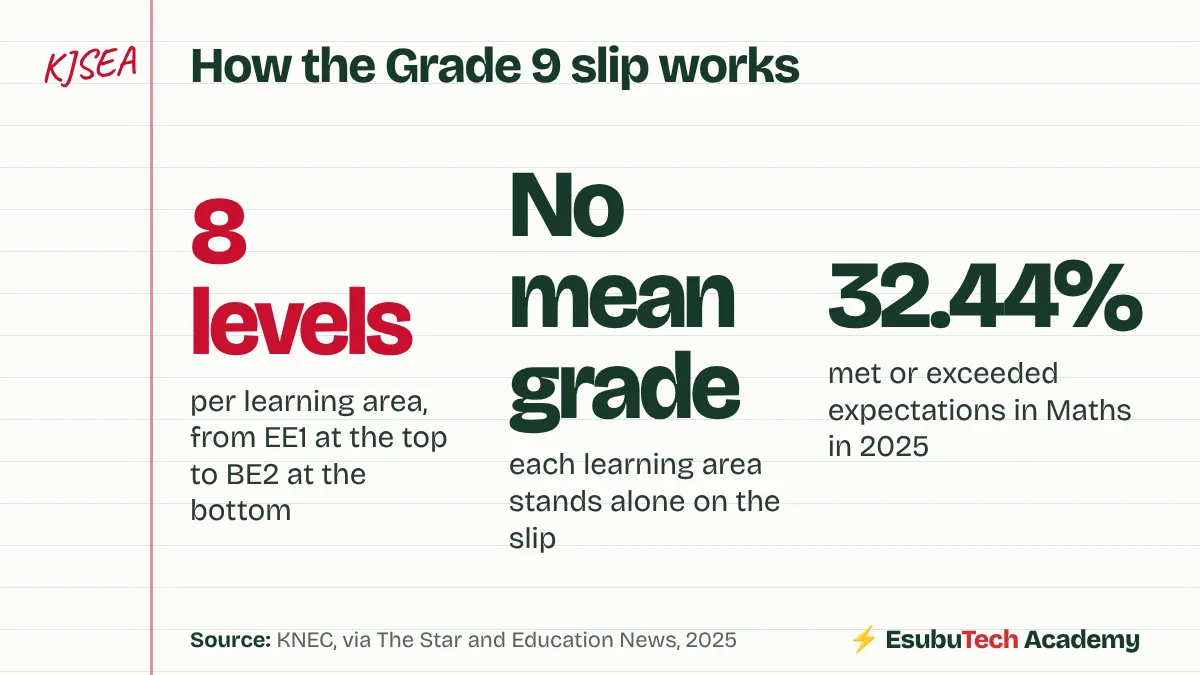
KJSEA doesn’t work like this. KNEC reports each learning area on its own, as one of eight levels, with no aggregate and no mean grade. A weak subject doesn’t drag a strong one down, and a strong one doesn’t hide a weak one.
Ask yourself what a single number hid in your own schooling. A B-plus mean grade covers a child who loved chemistry and hated history as neatly as it covers a child who was average at everything. Those are two different children, heading for different lives. The new slip shows you which child you have.
The slip isn’t a score for your child. It’s a map of where your child is strong and where the ground is thin.
The eight levels, in plain words
Each level is a band of the marks your child earned in one learning area.
| Level | Band | Points | What it says about the subject |
|---|---|---|---|
| EE1 | 90 to 100% | 8 | Well beyond the expected level |
| EE2 | 75 to 89% | 7 | Above the expected level |
| ME1 | 58 to 74% | 6 | Solid, grade-level mastery |
| ME2 | 41 to 57% | 5 | Grade-level mastery, with less margin |
| AE1 | 31 to 40% | 4 | Partial mastery, needs support |
| AE2 | 21 to 30% | 3 | Partial mastery, needs more support |
| BE1 | 11 to 20% | 2 | Needs targeted help |
| BE2 | 1 to 10% | 1 | Needs targeted help |
Look at the gap inside one letter. An ME2 at 41% and an ME1 at 74% share the word “Meeting”, and they sit 33 percentage points apart. Read the number after the letters as closely as the letters themselves.
Read the slip in three passes
First pass: circle every subject at ME1 or above. These are your child’s strengths. Say them out loud to your child before you mention anything else.
Second pass: mark every AE and BE. Write them on a sheet of paper, lowest first.
Third pass: check the subjects linked to the pathway your child wants. STEM placement leans on Mathematics and the sciences. An AE2 in Mathematics for a child set on STEM is the most urgent line on the page. Our post on preparing for the STEM pathway explains how placement uses those subjects.
What to do with each level
- EE: stretch it. Find a harder book, a club or a project in the subject. Strength grows when it gets used.
- ME1: protect it. Keep the routine which got your child here, and add one challenge.
- ME2: shore it up. Ask the teacher which topics cost the marks, and spend the holiday on those topics only.
- AE: go back to the groundwork. An AE in Mathematics often points to gaps from Grades 5 and 6, such as fractions, place value and times tables. Fill the gap before adding new topics.
- BE: ask the school for a meeting this term, and ask what support exists. A BE is a request for help, and the earlier help starts, the more it does.
Check the system yourself
KNEC’s explanation and the Education News guide sit at the bottom of this page. Read them before you read anyone’s summary, including mine. Then talk to your child’s class teacher. Teachers saw the school-based assessments behind these levels, and they know which topics went wrong.
Ask one more question, at home. Which subject does your child light up about, whatever the level says? Write it down next to the strengths. Grade 10 lasts three years, and a child who chose what they care about works harder for it than any slip predicts.
Check this yourself
The sources behind this post. Read them, and read the people who disagree, before you decide.
- KNEC explains new KJSEA grading system (The Star, 15 December 2025)Eight levels, no aggregate or mean grade, and a warning about fake mean-grade analyses.
- Beyond the marks: a clear guide to interpreting KJSEA results (Education News, 12 December 2025)The percentage band and points for each level.
- New KJSEA grading system leaves parents, students confused (Citizen Digital)Parents' questions after the first results.
- KJSEA Grade 9 results out by December 11 (Capital FM, November 2025)Last year's timeline: results on 11 December, placement before Christmas.
- Mathematics, Kenyan Sign Language post lowest scores in 2025 KJSEA (Education News)32.44% met or exceeded expectations in Mathematics.
Sammy founded Esubu Tech Academy and designs its coding and chess curriculum. He holds a BSc in Data Science from KCA University and is studying for an MSc in Artificial Intelligence at the Open University of Kenya. He learned to code as an adult, after years of unfinished tutorials, and teaches children so they start sooner.