Keeping your child safe online in Kenya: what the new rules ask of companies, and what stays with you
Since October 2025, companies serving Kenyan children have had new duties. The rules help. They don't sit beside your child at nine o'clock at night.

, 4 min read
On this page
It’s nine o’clock on a school night. Your daughter is in her room with the family tablet, finishing a game she plays with friends. A message pops up in the game’s chat from a player she doesn’t know. He’s friendly. He asks which school she goes to.
Most parents picture danger online as something dramatic. In practice it often starts like this: an ordinary app, a polite stranger and a small question.
“The new law protects my child now”
Kenya did tighten the rules. On 29 April 2025, the Communications Authority of Kenya adopted Industry Guidelines for Child Online Protection and Safety, and companies had until 29 October 2025 to comply. They cover the whole chain: mobile networks, internet providers, phone makers, apps, streaming and messaging services.
The guidelines ask companies to:
- Turn on the strictest privacy settings by default for children
- Check users’ ages, or put children in a child-friendly mode
- Tell parents how to switch on parental controls on their devices
- Run a clear complaints process and report child-safety complaints to the Authority every quarter
This is real progress. Now look at what it covers. Every item is a duty on a company. None of them knows your child, which apps she opens, who her friends are, or what happened in her room at nine o’clock.
The rules make the platform safer. Only a conversation makes your child safer.
Four kinds of risk, and what a filter catches
Researchers Sonia Livingstone and Mariya Stoilova sorted online risks to children into four groups, the 4Cs. Child-safety organisations such as the NSPCC now teach with them.
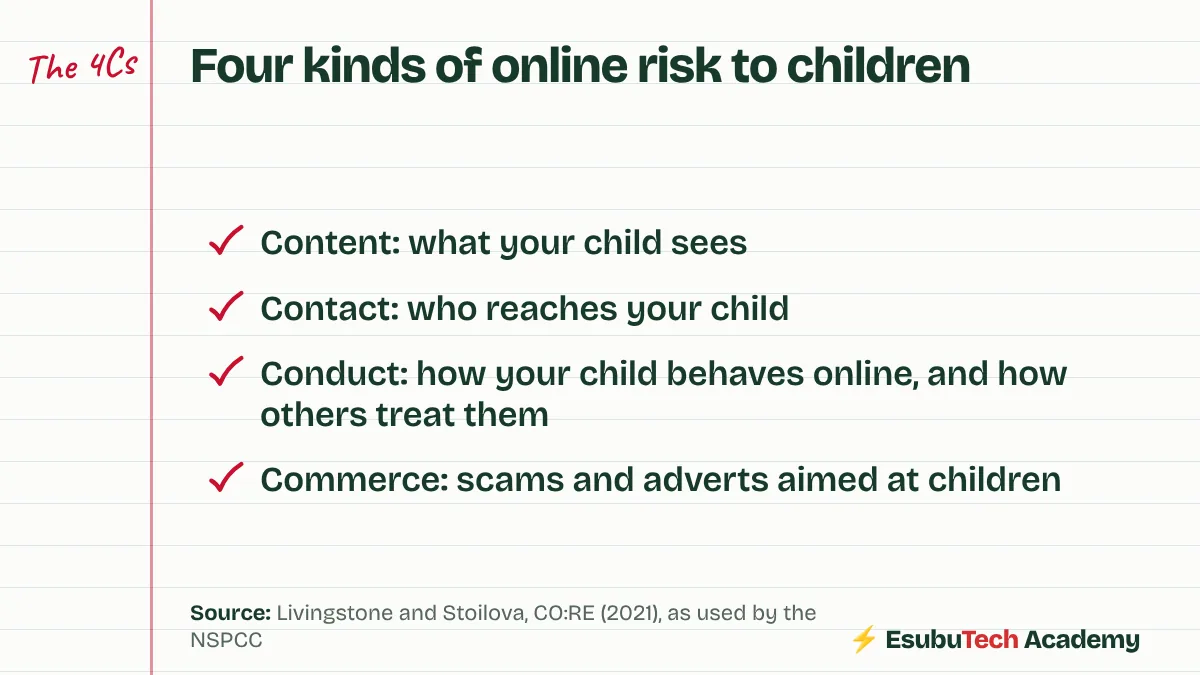
Filters and parental controls work best on content: they block sites and age-rated apps. They do far less for contact, a stranger in a game chat, and almost nothing for conduct, the unkind group message or the photo shared without asking. Those two need a child who talks to you.
Think about your own home. If your child told you tomorrow about a strange message, what would happen next? If the answer is “the tablet goes in the drawer for a month”, your child knows it too. Next time, they’ll stay quiet to keep the tablet.
Your child’s data, and your rights
Kenya’s Office of the Data Protection Commissioner published guidance on children’s data. Under the Data Protection Act, a child is anyone under 18, and an organisation processing a child’s personal data needs verifiable consent from a parent or guardian.
The guidance gives you rights worth using:
- Ask any school, app or class provider what data they collect about your child, and why
- Withdraw consent, ideally through the same channel you gave it
- Ask for your child’s data to be corrected or deleted
It also tells schools to get parents’ consent before publishing a child’s name, photo or scores, even for a prize-giving announcement. You’re allowed to say no.
A plan for your home
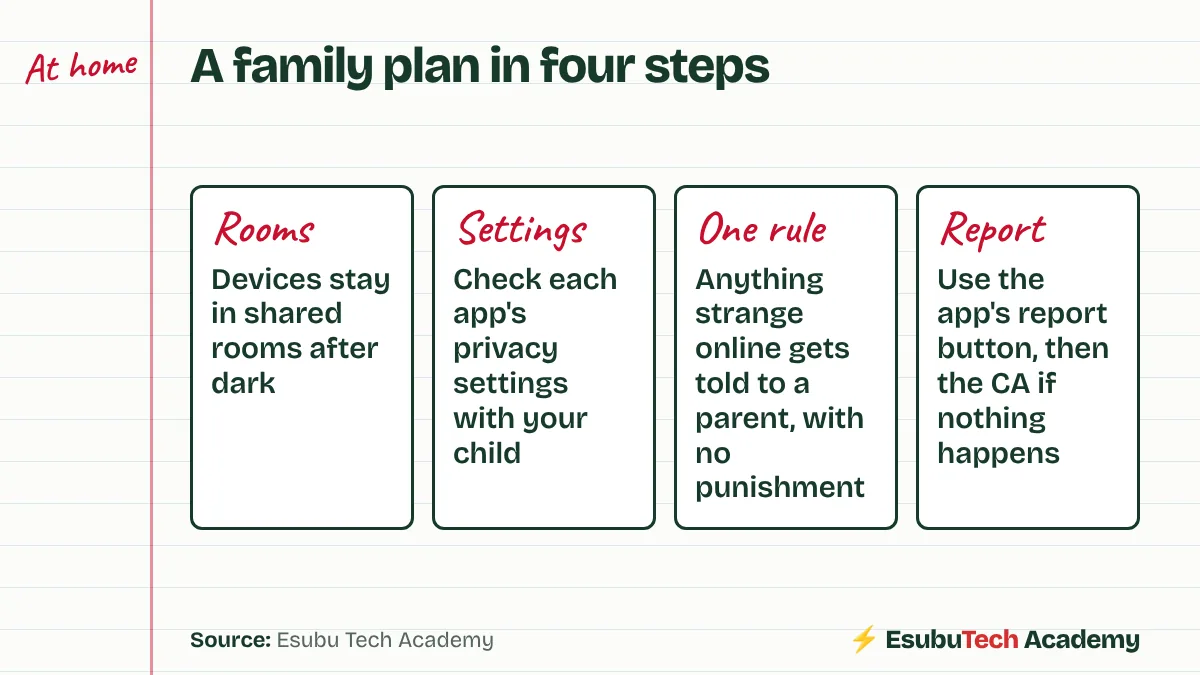
Sit with your child and open each app together. Look at who is allowed to message them, who sees their profile, and whether their location is shared. Many children know these menus well, and asking them to show you turns a lecture into a conversation.
Agree on one rule and say it plainly: if anything online feels strange, tell a parent, and nobody gets punished for telling. Then keep your word the first time it’s tested.
Read the rules, then ask questions
Read the summaries of the Communications Authority guidelines and the Data Commissioner’s guidance note, linked below. Then ask your child’s school two questions: what data do you hold about my child, and where do you publish children’s photos?
For phones, our post on the right age for a first smartphone walks through the settings to change before you hand one over. If a laptop is on the list this December, read what to check before you buy one.
Check this yourself
The sources behind this post. Read them, and read the people who disagree, before you decide.
- CA sets October 2025 deadline for child online safety guidelines (Tech-ish)Adopted 29 April 2025, compliance by 29 October 2025. Default privacy, age checks, parental control information, complaints.
- Industry guidelines for child online protection enter into force (Digital Policy Alert)Confirms both dates and the sectors covered, from telecoms to messaging apps.
- Protecting Kenyan children online: key industry guidelines (CIPIT, Strathmore University)Summary: age verification, heightened default privacy settings, reporting processes.
- Guidance note for processing children's data (Office of the Data Protection Commissioner)A child is anyone under 18. Parents give and withdraw consent. Schools need consent to publish names and photos.
- The 4 Cs of online safety (NSPCC Learning)Content, contact, conduct and commerce, from Livingstone and Stoilova (2021).
- Childline Kenya (Child Helpline International)Dial 116, toll free, 24 hours a day, seven days a week.
Sammy founded Esubu Tech Academy and designs its coding and chess curriculum. He holds a BSc in Data Science from KCA University and is studying for an MSc in Artificial Intelligence at the Open University of Kenya. He learned to code as an adult, after years of unfinished tutorials, and teaches children so they start sooner.