Buying a laptop for a child learning to code in Kenya: what to check before you pay
December is laptop season in many Kenyan homes. Before you pay, look past the price tag at four things: the processor, the version of Windows, the battery and the warranty.

, 5 min read
On this page
Walk down Luthuli Avenue in December and you’ll see the same scene in shop after shop. A parent, a child, and two laptops open on the counter. The attendant taps one of them: “This one is Core i7.” The parent looks at the price, then at the child, and reaches for the wallet.
A child learning to code needs less machine than most parents expect. The money goes wrong somewhere else: in an old version of Windows, a tired battery and a warranty nobody wrote down.
“A more expensive laptop helps my child learn faster”
Look at what a beginner runs. Scratch works in a web browser. A first Python program, a quiz or a guessing game, runs on almost any laptop sold in the last ten years. A Zoom class needs a webcam, a microphone and a steady connection.
None of this needs a gaming laptop or the newest model. A refurbished business laptop with 8GB of memory and an SSD handles all of it with room to spare. Business models such as the HP EliteBook and Dell Latitude were built for office use, with sturdy keyboards, and they fill most of the refurbished listings we checked.
So the spec decision is quick. The harder questions come after you’ve picked a model.
Same laptop, three prices
We looked up one model, the HP EliteBook 840 G5 with a Core i5 8th generation chip, 8GB of memory and a 256GB SSD, at three Kenyan shops on the same day.
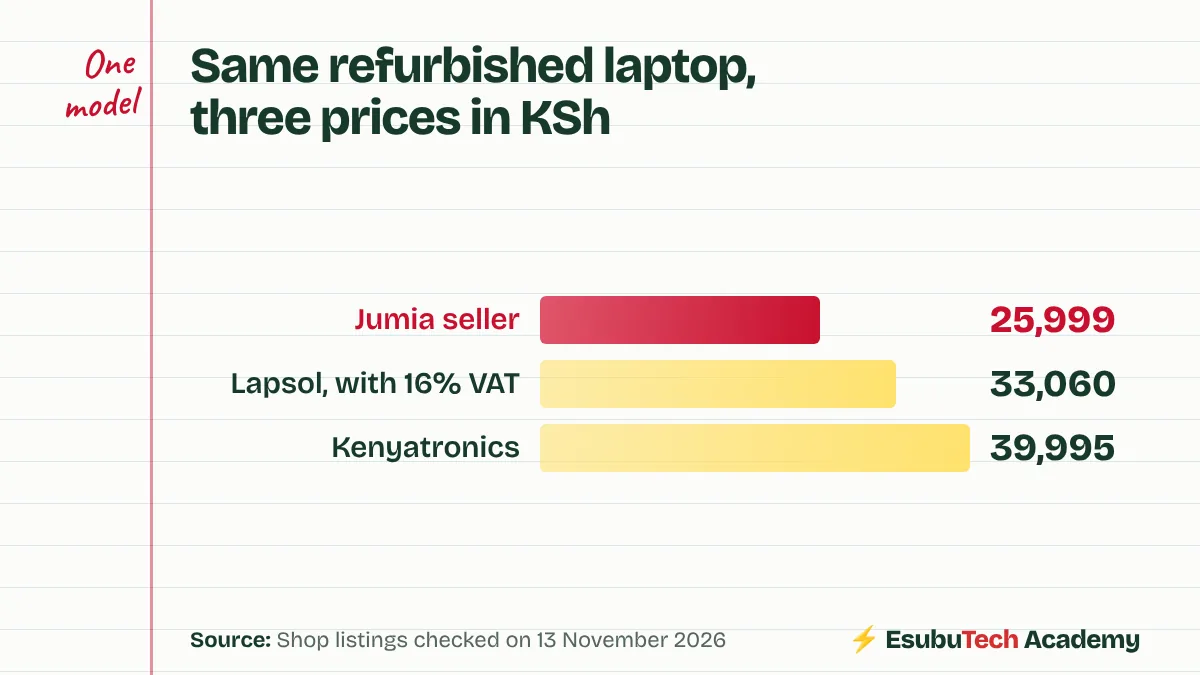
The cheapest and the dearest are about KSh 14,000 apart for the same model on paper. Part of the gap is the warranty: six months at one shop, a year at another, nothing stated at the third. Lapsol’s price also leaves out VAT, so it looks cheaper online than it is at the till.
The price tells you about the shop. The receipt tells you about the laptop.
Ask what the extra money pays for. If the answer is a longer warranty in writing, it’s buying you something. If the answer is “it’s a better one”, ask the attendant to show you how.
The Windows 10 problem
Microsoft ended support for Windows 10 on 14 October 2025. Home users had the option to pay for a year of extra security updates, and those ended on 13 October 2026. Today, a laptop running Windows 10 gets no security fixes at all.
Many refurbished laptops in Kenyan shops still ship with it. One of the three listings above names Windows 10 Pro in its title. A child’s laptop goes online every day, for classes, homework and games. It should be getting updates.
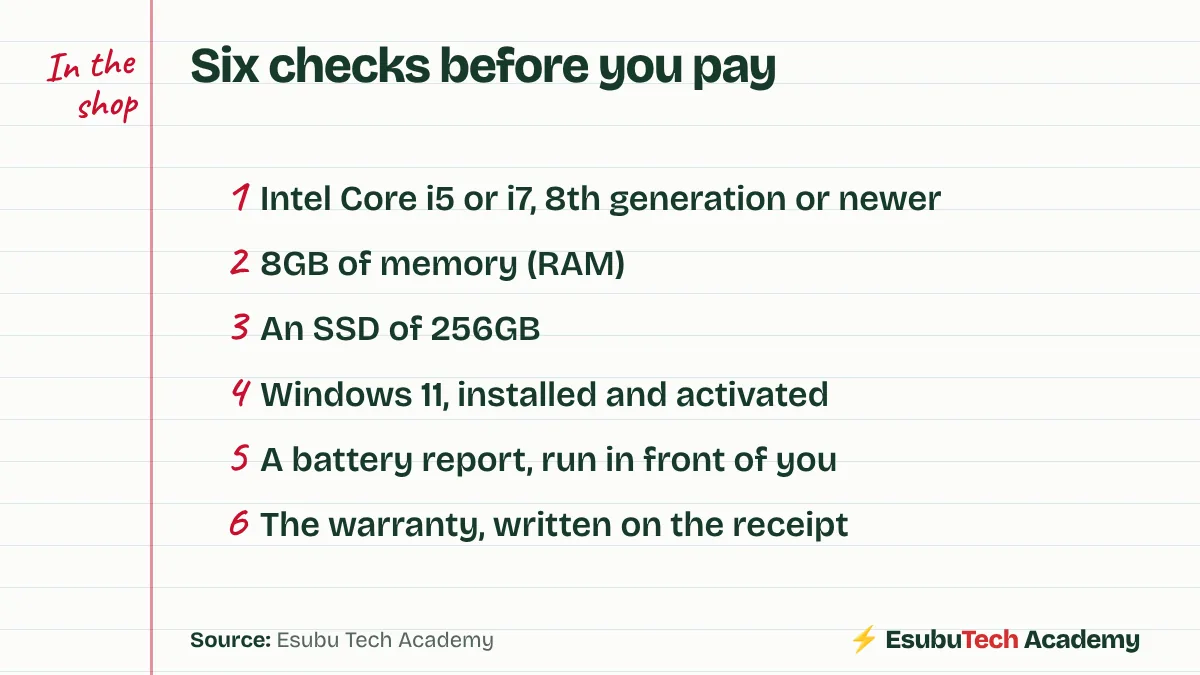
Microsoft’s list of processors for Windows 11 includes Intel’s 8th generation and newer. Read the generation from the processor name on the sticker or in the shop’s listing:
- Core i5-8350U: the first digit after the dash is 8, so 8th generation
- Core i5-7200U: 7th generation, below the list
- Core i5-10210U: the first two digits are 10, so 10th generation
Ask the shop to start the laptop and open Settings, then System, then About. Check it says Windows 11 and shows as activated.
The battery test, in the shop
A refurbished laptop’s battery has already lived one life. Windows records how much it has lost, and you’ll read it in two minutes.
Open PowerShell or Command Prompt and type powercfg /batteryreport. Windows saves a file called battery-report.html in the user folder. Open it and compare two numbers: the design capacity, what the battery held when new, and the full charge capacity, what it holds today.
How-To Geek’s example shows a battery designed for 44,400 mWh holding 37,685 mWh, about 85% of its original charge. Decide your own floor before you go. A battery at half its design capacity means a laptop tied to the socket, and in a home with power cuts, a lost class.
Ask what the laptop is for
Most parents skip one question. A year from now, what will your child have done on this laptop?
If the honest answer is YouTube and games, the spec won’t matter, and the laptop becomes a bigger phone. If the answer is “built three games and learnt to type”, the laptop needs a place to live in the house, a time when it’s used, and a reason to open it. Our guide to keeping your child safe online in Kenya covers the settings to change before handing it over.
Check the prices yourself
Prices move every week, and our numbers are from one day in November. Open three listings for the same model, compare the warranty on each, and ask every shop the same questions: which Windows, which processor generation, which battery health, how long a warranty, and is it on the receipt.
If you’d like help securing one, send us your budget on WhatsApp and we’ll recommend a laptop to fit it, with the checks to run before you pay.
If you’re weighing a phone or tablet instead, read our post on learning to code on a phone first.
Check this yourself
The sources behind this post. Read them, and read the people who disagree, before you decide.
- HP EliteBook 840 G5, refurbished, KSh 25,999 (Jumia Kenya listing)Checked 13 November 2026. Six-month warranty. Prices change often.
- HP EliteBook 840 G5, refurbished, KSh 28,500 excluding VAT (Lapsol)Checked 13 November 2026. No warranty stated on the page.
- HP EliteBook 840 G5, refurbished, KSh 39,995 (Kenyatronics)Checked 13 November 2026. One-year warranty. Listed with Windows 10 Pro.
- Windows 10 end of support, 14 October 2025 (Pureinfotech)No more free security updates. Home users' Extended Security Updates ran until 13 October 2026.
- Microsoft confirms Intel 8th, 9th and 10th gen chips on the Windows 11 list (Neowin)Microsoft's February 2025 correction to its processor list.
- How to generate a battery health report on Windows (How-To Geek)The powercfg command, and how to compare design capacity with full charge capacity.
Sammy founded Esubu Tech Academy and designs its coding and chess curriculum. He holds a BSc in Data Science from KCA University and is studying for an MSc in Artificial Intelligence at the Open University of Kenya. He learned to code as an adult, after years of unfinished tutorials, and teaches children so they start sooner.